1,830 posters, 67 videos, 75 audios, 29 topics, 22 sessions, 4,727 authors, 1,697 institutions
ePostersLive by SciGen Technologies S.A. All rights reserved.
RCOG World Congress 2023
June 12 - 14, 2023 | London, UK

EP.0039
Impact of cancer on reproductive outcomes of women undergoing oocyte cryopreservation
Poster Presenter
Part of Topic
Reproductive Medicine/Assisted Reproduction
Video
Does cancer reduce a woman's chance of getting pregnant? A retrospective study
Background
Cancer survivorship is increasing worldwide and subsequently the demand for urgent fertility preservation (FP) is growing. There remains limited evidence on the optimal management for women seeking FP, particularly those with cancer.
Aims and Objectives
The aim of this study was to evaluate reproductive outcomes of women with breast cancer (BC), haematological cancer (HC) and healthy controls seeking oocyte cryopreservation, and the potential confounding factors. The purpose of this study is to develop more evidence towards the optimum protocol for COS.
Methods
Data was extracted on patient and treatment characteristics and reproductive outcomes. Data was electronically recorded, uniquely coded, checked, and pseudo-anonymised. Descriptive statistics, natural frequencies, Pearson correlation and linear regression models were employed to summarise the outcomes, with p<0.05 indicating a statistical significance. The primary outcome was the number of oocytes; mature (MII) and immature (GV). The study was a service evaluation of routine practice and therefore exempt from ethical approval.
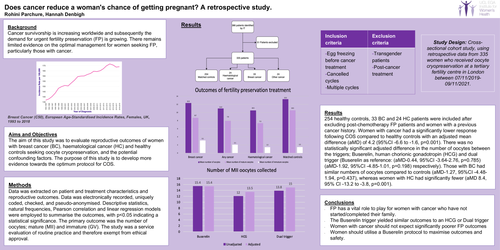
Study Design: Cross-sectional cohort study, using retrospective data from 335 women who received oocyte cryopreservation at a tertiary fertility centre in London between 07/11/2019-09/11/2021.
Results
254 healthy controls, 33 BC and 24 HC patients were included after excluding post-chemotherapy FP patients and women with a previous cancer history. Women with cancer had a significantly lower response following COS compared to healthy controls with an adjusted mean difference (aMD) of 4.2 (95%CI -6.6 to -1.6, p=0.001). There was no statistically significant adjusted difference in the number of oocytes between the triggers; Buserelin, human chorionic gonadotropin (HCG) and dual trigger (Buserelin as reference: (aMD-0.44, 95%CI -3.64-2.76, p=0.785) (aMD-1.92, 95%CI -4.85-1.01, p=0.198) respectively). Those with BC had similar numbers of oocytes compared to controls (aMD-1.27, 95%CI -4.48-1.94, p=0.437), whereas women with HC had significantly fewer (aMD 8.4, 95% CI -13.2 to -3.8, p=0.001).
Conclusions