1,830 posters, 67 videos, 75 audios, 29 topics, 22 sessions, 4,727 authors, 1,697 institutions
ePostersLive by SciGen Technologies S.A. All rights reserved.
RCOG World Congress 2023
June 12 - 14, 2023 | London, UK

EP.0978
Comparing the efficiency of Cervical balloon Versus Dilapan for induction of labour
Poster Presenter
Authors
Affiliations
Part of Topic
Labour Ward Management
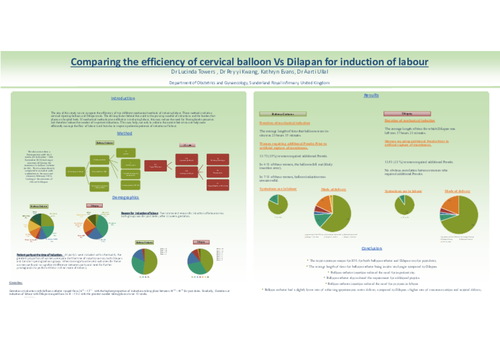
Comparing the efficiency of cervical balloon Vs Dilapanfor induction of labour
Introduction:
The aim of this study was to compare the efficiency of two different mechanical methods of inducing labour. These methods include a cervical ripening balloon and Dilapan rods. The driving factor behind this audit is the growing number of inductions and the burden that places on hospital beds. If mechanical methods prove effective in inducing labour, this may reduce the need for Prostaglandin pessaries and therefore reduce the number of in-patient inductions. This may help, not only to address the current bed crisis and help more efficiently manage the flow of labour ward but also to improve patient experience of induction of labour
Method:
This data come from a Retrospective audit for 5 weeks (25th October – 28th November 2022) looking at outcomes following the insertion of a balloon catheter for IOL. This has been directly compared to an earlier audit undertaken in the same unit (January- February 2021) looking at the outcomes of IOL with Dilapan.
Demographics:
Reason for Induction of labour: The commonest reason for induction of labour across both groups was for post dates, after 41 weeks gestation.
Patient parity at the time of induction: All parity’s were included within the Audits, the greatest proportion of women were para 0 at the time of induction across both Dilapan and Cervical ripening balloon groups. When looking at our desired outcomes for these women we found no significant difference between parity and need for further prostaglandin to perform ARM or in final mode of delivery.
Gestation:
Gestation at induction with balloon catheter ranged from 36+6 - 41+ 1 with the highest proportion of inductions taking place between 40+0 - 40+6 for post dates. Similarly, Gestation at induction of labour with Dilapan ranged from 36+0 - 41+2 with the greatest number taking place at over 41 weeks.