1,830 posters, 67 videos, 75 audios, 29 topics, 22 sessions, 4,727 authors, 1,697 institutions
ePostersLive by SciGen Technologies S.A. All rights reserved.
RCOG World Congress 2023
June 12 - 14, 2023 | London, UK

EP.0090
Tachypnoea as a Marker for Severity of Postpartum Haemorrhage
Poster Presenter
Authors
Deanne Xu, Tristan McCaughey, Lauren De Luca, Anthony Woodward, Mark Umstad
Affiliations
Part of Topic
Labour Ward Management
Tachypnoea as a Marker for Severity of Postpartum Haemorrhage
Deanne Xu, Tristan McCaughey, Lauren De Luca, Anthony Woodward, Mark Umstad
Royal Women’s Hospital, Victoria, Australia
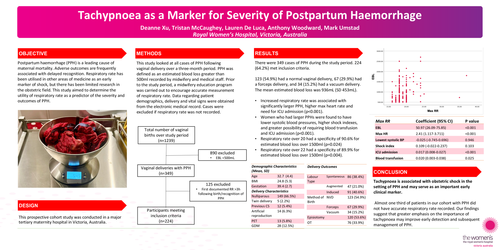
Objective: Postpartum haemorrhage (PPH) is a leading cause of maternal mortality. Adverse outcomes are frequently associated with delayed recognition. Respiratory rate has been utilised in other areas of medicine as an early marker of shock, but there has been limited research in the obstetric field. This study aimed to determine the utility of respiratory rate as a predictor of the severity and outcomes of PPH.
Design: This prospective cohort study was conducted in a major tertiary maternity hospital.
Methods: This study looked at all cases of PPH following vaginal delivery over a three-month period. PPH was defined as an estimated blood loss greater than 500ml recorded by midwifery and medical staff. Prior to the study period, a midwifery education program was carried out to encourage accurate measurement of respiratory rate. Data regarding patient demographics, delivery and vital signs were obtained from the electronic medical record. Cases were excluded if respiratory rate was not recorded.
Results: There were 349 cases of PPH during the study period. 224 (64.2%) met inclusion criteria. 123 (54.9%) had a normal vaginal delivery, 67 (29.9%) had a forceps delivery, and 34 (15.2%) had a vacuum delivery. The mean estimated blood loss was 936mL (SD 453mL). Increased respiratory rate was associated with significantly larger PPH, higher max heart rate and need for ICU admission (p<0.001). Women who had larger PPHs were found to have lower systolic blood pressures, higher shock indexes, and greater possibility of requiring blood transfusion and ICU admission (p<0.001). Respiratory rate over 20 had a specificity of 90.6% for estimated blood loss over 1500ml (p=0.024), and respiratory rate over 22 had a specificity of 89.9% for estimated blood loss over 1500ml (p=0.004).
Conclusion: Tachypnoea is associated with obstetric shock in the setting of PPH and may serve as an important early clinical marker. Almost one third of patients in our cohort with PPH did not have accurate respiratory rate recorded. Our findings suggest that greater emphasis on the importance of tachypnoea may improve early detection and subsequent management of PPH.