1,830 posters, 67 videos, 75 audios, 29 topics, 22 sessions, 4,727 authors, 1,697 institutions
ePostersLive by SciGen Technologies S.A. All rights reserved.
RCOG World Congress 2023
June 12 - 14, 2023 | London, UK

EP.0977
Twelve Months of Monochorionic Twins – Local Management Versus Tertiary Centre Interventions
Poster Presenter
Authors
Affiliations
Part of Topic
Fetal Medicine
Twelve Months of Monochorionic Twins: Local Management Versus Tertiary Centre Interventions
Glenn Davies, Obstetrics & Gynaecology Specialty Trainee Year 6, University Hospital North Midlands NHS Trust
Gomathy Gopal, Consultant Obstetrician, University Hospital of North Midlands NHS Trust
Introduction
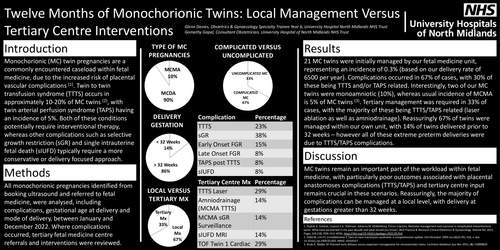
Monochorionic (MC) twin pregnancies are a commonly encountered caseload within fetal medicine, due to the increased risk of placental vascular complications (1). Twin to twin transfusion syndrome (TTTS) occurs in approximately 10-20% of MC twins (2), with twin arterial perfusion syndrome (TAPS) having an incidence of 5%. Both of these conditions potentially require interventional therapy, whereas other complications such as selective growth restriction (sGR) and single intrauterine fetal death (sIUFD) typically require a more conservative or delivery focused approach.
Methods
All monochorionic pregnancies identified from booking ultrasound and referred to fetal medicine, were analysed, including complications, gestational age at delivery and mode of delivery, between January and December 2022. Where complications occurred, tertiary fetal medicine centre referrals and interventions were reviewed.
Results
21 MC twins were initially managed by our fetal medicine unit, representing an incidence of 0.3% (based on our delivery rate of 6500 per year). Complications occurred in 67% of cases, with 30% of these being TTTS and/or TAPS related. Interestingly, two of our MC twins were monoamniotic (10%), whereas usual incidence of MCMA is 5% of MC twins (3). Tertiary management was required in 33% of cases, with the majority of these being TTTS/TAPS related (laser ablation as well as amniodrainage). Reassuringly 67% of twins were managed within our own unit, with 14% of twins delivered prior to 32 weeks – however all of these extreme preterm deliveries were due to TTTS/TAPS complications.
Discussion
MC twins remain an important part of the workload within fetal medicine, with particularly poor outcomes associated with placental anastomoses complications (TTTS/TAPS) and tertiary centre input remains crucial in these scenarios. Reassuringly, the majority of complications can be managed at a local level, with delivery at gestations greater than 32 weeks.
References
1. Sophie G. Groene, Lisanne S.A. Tollenaar, Johanna M. Middeldorp, Enrico Lopriore, Neonatal management and outcome in complicated monochorionic twins: What have we learned in the past decade and what should you know?, Best Practice & Research Clinical Obstetrics & Gynaecology, Volume 84, 2022, Pages 218-228, ISSN 1521-6934, https://doi.org/10.1016/j.bpobgyn.2022.03.016.
2. Habli M, Lim FY, Crombleholme T. Twin-to-twin transfusion syndrome: a comprehensive update. Clin Perinatol. 2009 Jun;36(2):391-416, x. doi: 10.1016/j.clp.2009.03.003. PMID: 19559327.
3. Shub A, Walker SP. Planned early delivery versus expectant management for monoamniotic twins. Cochrane Database Syst Rev 2015; (4): CD008820.