1,830 posters, 67 videos, 75 audios, 29 topics, 22 sessions, 4,727 authors, 1,697 institutions
ePostersLive by SciGen Technologies S.A. All rights reserved.
RCOG World Congress 2023
June 12 - 14, 2023 | London, UK

EP.0975
Impact of operative delivery on birth experience: a reflective qualitative analysis
Part of Topic
Labour Ward Management
Impact of operative delivery on birth experience: a reflective qualitative analysis
Nadia Muspratt-Tucker1, Aditi Siddharth2
1Oxford University Hospitals NHS Foundation Trust, Oxford, United Kingdom. 2Nuffield Department of Clinical Neurosciences, University of Oxford, Oxford, United Kingdom
BACKGROUND
Childbirth is a significant life event [1] and 20% of women report having a negative experience. There are short-term and long-term consequences to consider, from difficulty breastfeeding and bonding with the baby to post-traumatic stress disorder and postnatal depression [1]. Studies indicate a loss of the feeling of empowerment and control impact the birth experience even more than mode of birth and complications [2, 3]. The purpose of this analysis was to obtain the views of women on their operative delivery, identify aspects of their delivery that were important to them and reflect on the findings from a trainee’s perspective in order to promote reflective learning for trainees to improve. While interventions in the context of obstetrics are often not patient’s preferred modes of birth, this analysis aims to identify factors that improve patient experience in this area.
Methods
Qualitative methods were chosen to explore patient perceptions of their birth and allow the voice of the patient to be reflected upon. Semi-structured interviews were conducted between 2 and 3 weeks postpartum, for 25 women who had undergone forceps, ventouse or caesarean section delivery, performed by one obstetric trainee. These were transcribed and the transcripts coded line-by-line to identify themes. Sampling was continued until thematic saturation was achieved. The results of the thematic analysis were critically reflected on to synthesise learning that can enhance trainee practice. This review was ethics exempt as it was a service evaluation.
Results
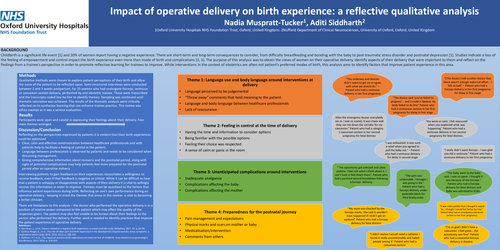
Participants were open and candid in expressing their feelings about their delivery. Four main themes emerged
Theme 1: Language use and body language around interventions at delivery
Theme 2: Feeling in control at the time of delivery
Theme 3: Unanticipated complications around interventions
Theme 4: Preparedness for the postnatal journey
Discussion/Conclusion
Reflecting on the perspectives expressed by patients it is evident that their birth experiences could be optimised
Interviewing patients to gain feedback on their experiences necessitates a willingness to receive feedback, even if that feedback is negative or critical. While it can be difficult to hear that a patient is unhappy or disappointed with aspects of their delivery it is vital to willingly receive this information in order to improve. Trainees must be sensitised to the factors that influence patient experiences during birth. Reflecting on one’s own performance during an operative delivery - keeping in mind the themes that arose in this review- is vital to becoming a better clinician.
There are limitations to this analysis – the doctor who performed the operative delivery is in a position of relative power compared to the patient which may affect the quality of the responses given. The patient may also feel unable to be honest about their feelings to the person who performed the delivery. Further work is needed to identify practices that improve the patient experience of operative delivery.