1,830 posters, 67 videos, 75 audios, 29 topics, 22 sessions, 4,727 authors, 1,697 institutions
ePostersLive by SciGen Technologies S.A. All rights reserved.
RCOG World Congress 2023
June 12 - 14, 2023 | London, UK

EP.0965
OUTCOME OF INDUCTION METHODS IN TRIAL OF LABOUR AFTER CAESAREAN SECTION
Poster Presenter
Part of Topic
High Risk Pregnancy
AN AUDIT ON OUTCOME OF INDUCTION METHODS IN TRAIL OF LABOUR AFTER CAESAREAN SECTION AT CASTLE STREET HOSPITAL FOR WOMEN,COLOMBO
Kamalathasan P, Jothiji S, Ratnasiri UDP
Castle Street Hospital for Women, Colombo, Sri Lanka
Introduction: It is observed that rising trend in caesarean section (CS) in Sri Lanka1. As a result, the number of women with previous CS scars is increasing. An option for women with previous CS scar for the next pregnancy delivery is a trial of labour after caesarean (TOLAC). The outcome of TOLAC can be vaginal birth, emergency CS or routine CS2. TOLAC is a clinically safe practice even with induction methods.
Methods: A prospective audit was conducted from September 2018 to February 2019 at wards 9 and 10 of Castle Street Hospital for Women. The study includes 58 Pregnant mothers with single previous CS. The decision for TOLAC was made after the assessment and discussion with mothers at around 36-37 weeks at the antenatal clinic. The onset of labour is achieved by spontaneous or induction methods (Artificial Separation of Membrane; Foley with oxytocin; amniotomy with oxytocin).
Objective: Aim to evaluate the success rate of spontaneous and induced TOLAC and assess the outcome of different induction methods.
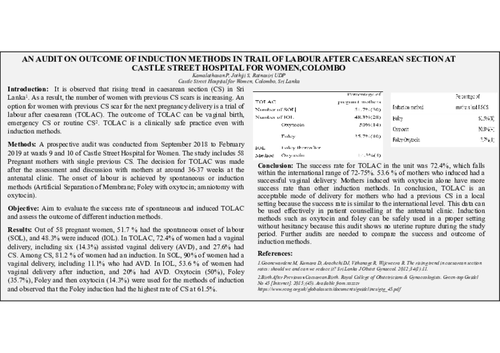
Results: Out of 58 pregnant women, 51.7 % had the spontaneous onset of labour (SOL), and 48.3% were induced (IOL). In TOLAC, 72.4% of women had a vaginal delivery, including six (14.3%) assisted vaginal delivery (AVD), and 27.6% had CS. Among CS, 81.2 % of women had an induction. In SOL, 90% of women had a vaginal delivery, including 11.1% who had AVD. In IOL, 53.6 % of women had vaginal delivery after induction, and 20% had AVD. Oxytocin (50%), Foley (35.7%), Foley and then oxytocin (14.3%) were used for the methods of induction and observed that the Foley induction had the highest rate of CS at 61.5%.
Conclusion: The success rate for TOLAC in the unit was 72.4%, which falls within the international range of 72-75%. 53.6 % of mothers who induced had a successful vaginal delivery. Mothers induced with oxytocin alone have more success rate than other induction methods. In conclusion, TOLAC is an acceptable mode of delivery for mothers who had a previous CS in a local setting because the success rate is similar to the international level. This data can be used effectively in patient counselling at the antenatal clinic. Induction methods such as oxytocin and foley can be safely used in a proper setting without hesitancy because this audit shows no uterine rupture during the study period. Further audits are needed to compare the success and outcome of induction methods.
References:
1.Goonewardene M, Kumara D, Arachchi DJ, Vithanage R, Wijeweera R. The rising trend in caesarean section rates: should we and can we reduce it? Sri Lanka J Obstet Gynaecol. 2012;34(1):11.
2.Birth After Previous sCaesarean Birth. Royal College of Obstetricians & Gynaecologists. Green-top Guidel No 45 [Internet]. 2015;(45). Available from:xxzzzv https://www.rcog.org.uk/globalassets/documents/guidelines/gtg_45.pdf