1,830 posters, 67 videos, 75 audios, 29 topics, 22 sessions, 4,727 authors, 1,697 institutions
ePostersLive by SciGen Technologies S.A. All rights reserved.
RCOG World Congress 2023
June 12 - 14, 2023 | London, UK

EP.0963
Stillbirths and Intrauterine Foetal Deaths during the COVID-19 Pandemic at the UHWI
Poster Presenter
Part of Topic
Pandemic and impact of Covid/Infectious Diseases
Video
Stillbirths and Intrauterine Deaths During the COVID-19 Pandemic at the UHWI: A Retrospective Cohort Study Comparing Rates of Stillbirths During and Prior to the Pandemic
Kymberly Jones, Michelle Campbell Mitchell, Cathy Maddan, Phillip Charles, Carole Rattray. Department of Obstetrics and Gynaecology. The University of the West Indies.
Introduction
Up to November 2022, over 6.5 million deaths related to the COVID-19 pandemic were reported universally [1]. Adverse effects related to the pandemic on maternal and perinatal health are not solely limited to morbidity and mortality caused by the direct effects of the virus. Other indirect factors have been observed to contribute to this. Our study aimed to compare the rates of stillbirth and intrauterine foetal demise at the UHWI in a pre-pandemic period versus pandemic period to potentially identify any significant trends. It also sought to identify any associated risk factors with these cases.
Methods
This was a retrospective cohort study of all cases diagnosed with intra- uterine foetal deaths after 13 weeks’ gestation or stillbirths at the University Hospital of the West Indies between March 10, 2018, to December 31, 2019, designated as the ‘pre-pandemic period’ (control) and those diagnosed between March 10, 2020, to December 31, 2021, designated as the ‘pandemic period’ (cases). COVID positive cases were defined as those having a positive polymerase chain reaction (PCR) test using a nasopharyngeal and/or oropharyngeal swab, and/or a positive rapid antigen test. The medical dockets were reviewed, and information was collected using a data collection tool.
Results
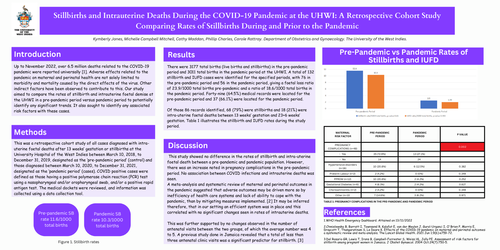
There were 3177 total births (live births and stillbirths) in the pre-pandemic period and 3011 total births in the pandemic period at the UHWI. A total of 132 stillbirth and IUFD cases were identified for the specified periods, with 76 in the pre-pandemic period and 56 in the pandemic period, giving a foetal loss ratio of 23.9/1000 total births pre-pandemic and a ratio of 18.6/1000 total births in the pandemic period. Forty-nine (64.5%) medical records were located for the pre-pandemic period and 37 (66.1%) were located for the pandemic period.
Of those 86 records identified, 68 (79%) were stillbirths and 18 (21%) were intra-uterine foetal deaths between 13 weeks’ gestation and 23+6 weeks’ gestation. Table 1 illustrates the stillbirth and IUFD rates during the study period.
Discussion
This study showed no difference in the rates of stillbirth and intra-uterine foetal death between a pre-pandemic and pandemic population. However, there was an increase noted in pregnancy complications in the pre-pandemic period. No association between COVID infections and intrauterine deaths was seen.
A meta-analysis and systematic review of maternal and perinatal outcomes in the pandemic suggested that adverse outcomes may be driven more so by inefficiency of health care systems and lack of ability to cope with the pandemic, than by mitigating measures implemented. [2] It may be inferred therefore, that in our setting an efficient system was in place and this correlated with no significant changes seen in rates of intrauterine deaths.
This was further supported by no changes observed in the number of antenatal visits between the two groups, of which the average number was 4 to 5. A previous study done in Jamaica revealed that a total of less than three antenatal clinic visits was a significant predictor for stillbirth. [3]
References
1.WHO Health Emergency Dashboard. Attained on 13/11/2022
2.Chmielewska B, Barratt I, Townsend R, Kalafat E, van der Meulen J, Gurol-Urganci I, O'Brien P, Morris E, Draycott T, Thangaratinam S, Le Doare K. Effects of the COVID-19 pandemic on maternal and perinatal outcomes: a systematic review and meta-analysis. The Lancet Global Health. 2021 Jun 1;9(6):e759-72.
3.Del Rosario GR, Lewis T, Irons B, Campbell-Forrester S, Weiss HL, Jolly PE. Assessment of risk factors for stillbirth among pregnant women in Jamaica. J Obstet Gynaecol. 2004 Oct;24(7):750-5.