1,830 posters, 67 videos, 75 audios, 29 topics, 22 sessions, 4,727 authors, 1,697 institutions
ePostersLive by SciGen Technologies S.A. All rights reserved.
RCOG World Congress 2023
June 12 - 14, 2023 | London, UK

EP.0047
COVID-19 lockdowns association with maternal and perinatal outcomes in high-income countries
Poster Presenter
Authors
Iona Hindes, Hawa Nuralhuda Sarwar, Lizbeth Burgos Ochoa, Benjamin Gravesteijn, Jasper Been, Dominik Zenner, Stamatina Iliodromiti
Affiliations
Queen Mary University London, Department of Obstetrics and Gynecology at Erasmus MC, Department of Public Health Erasmus MC, Erasmus MC – Sophia Children’s Hospital, University Medical Centre Rotterdam,
Part of Topic
Pandemic and impact of Covid/Infectious Diseases
Audio
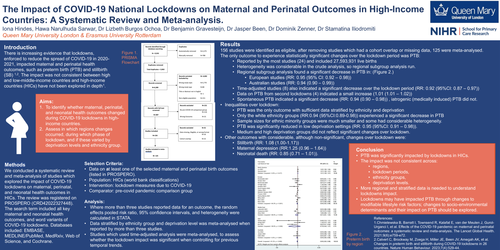
The Impact of COVID-19 National Lockdowns on Maternal and Perinatal Outcomes in High-Income Countries: A Systematic Review and Meta-analysis.
Introduction
There is increasing evidence that lockdowns, enforced to reduce the spread of COVID-19 in 2020-2021, impacted maternal and perinatal health outcomes, such as preterm birth (PTB) and stillbirth (SB) 1,2. The impact was not consistent between high and low-middle-income countries and high-income countries (HICs) have not been explored in depth1.
Aims:
Methods
We conducted a systematic review and meta-analysis of studies that explored the impact of COVID-19 lockdowns on maternal, perinatal, and neonatal health outcomes in HICs. The review was registered on PROSPERO (CRD42022327448).
The search term included all key maternal and neonatal health outcomes and word variants of COVID-19 lockdowns. Databases included: EMBASE, MEDLINE/PubMed, MedRxiv, Web of Science, and Cochrane.
Selection Criteria:
Analysis: Where more than three studies reported data for an outcome, the random effects pooled risk ratio, 95% confidence intervals, and heterogeneity was calculated in STATA.
Data stratified by ethnicity group and deprivation level was meta-analyzed when reported by more than three studies.
Studies that used time-adjusted analysis were meta-analyzed, to assess whether the lockdown impact was significant when controlling for previous temporal trends.
Results
156 studies were identified as eligible, after removing studies which had a cohort overlap or missing data, 125 were meta-analysed.
Conclusion
References:
1.Chmielewska B, Barratt I, Townsend R, Kalafat E, van der Meulen J, Gurol-Urganci I, et al. Effects of the COVID-19 pandemic on maternal and perinatal outcomes: a systematic review and meta-analysis. The Lancet Global Health. 2021;9(6):e759-e72.
2.Calvert C, Brockway M, Zoega H, Miller JE, Been JV, Amegah AK, et al. Changes in preterm birth and stillbirth during COVID-19 lockdowns in 26 countries. Nature Human Behaviour. 2023;7(4):529-44.