1,830 posters, 67 videos, 75 audios, 29 topics, 22 sessions, 4,727 authors, 1,697 institutions
ePostersLive by SciGen Technologies S.A. All rights reserved.
RCOG World Congress 2023
June 12 - 14, 2023 | London, UK

EP.0962
Qualitative content analysis of MPDSR audit meetings in Lamu County Hospital, Kenya.
Poster Presenter
Authors
Affiliations
Part of Topic
High Risk Pregnancy
Audio
THE QUALITATIVE CONTENT ANALYSIS OF MPDSR AUDIT MEETINGS IN LAMU COUNTY REFERRAL HOSPITAL, KENYA.
Author: Dr. Rehana Raja Senior Consultant OBGYN Master Trainer RH.
INTRODUCTION
MPDSR constitutes a quality improvement approach to identify how many maternal deaths occur (Surveillance), what the underlying causes of death and associated factors are (Review) and how to implement actions to reduce the number of preventable stillbirths, maternal and neonatal deaths (Response).
Currently in Kenya the maternal mortality ratio is 362per 100,000 live births perinatal mortality and the neonatal mortality is 29/1000 and 22/1000 live births respectively
Kenya made maternal death notification mandatory in 2004. The national guidelines for maternal and perinatal death surveillance and response MPDSR were launched in 2016 and the first Confidential Enquiry was published in 2017
The author served in the county for three years (2019-2022) and wondered why there was no shift in the MPDSR. Here some answers are shared.
Objectives
- To decipher the impact of “R” of MPDSR audit meetings in Lamu County Referral Hospital.
- To identify challenges and barriers in implementing MPDSR
DESIGN : Retrospective qualitative content analysis of 64 audit meetings held from 2015 to 2022 at Lamu County Referral Hospital
METHODOLOGY: The study used a qualitative design on inductive content analysis and latent analysis
Data Collection: Data was collected from 64 perinatal audit meeting reports from Lamu County and Referral Hospital between 2015 to 2022. Data on gaps identified, challenges, recommendations and action plans were recorded.
Analysis: The data was coded per transcript and additional new aspects that came up in the process of coding resulted to the recoding of the previous reports to include all the new codes. The codes were categorized and subcategorized based on similarities to form content category and a code book generated. A latent analysis of the content category and the sub categories were created to help understand the deeper meaning of the texts in the report.
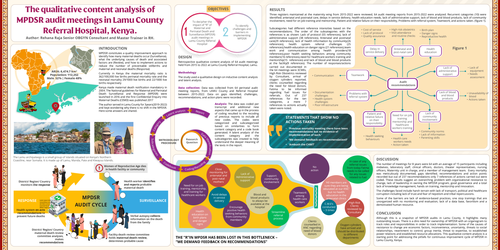
RESULTS: Three registers maintained at the maternity wing from 2015 to 2020 were analyzed. Recurrent categories (10) were identified: antenatal and postnatal care, delays in service delivery, health education needs, lack of administrative support, lack of blood and blood products, lack of community involvement, need for on job training and mentorship, patient and relative failure on their responsibility, problems with referral system, team work and actions taken (Figure 1).
Subcategories had different reference intensities based on the recommendations. The order of the subcategories with the references is as shown: Lack of protocols (55), lack of administrative support(38) references, antenatal and postnatal care(29), lack of health information by community (26) references, health system referral challenges (25 references), health education on danger signs (21 references), teamwork and communication among health providers (18)references, poor health seeking behavior among community members (16) references, need for health worker training and mentorship (15 references)and lack of blood and blood products at the facility (references). The number of responses/ actions carried out as documented in the 64 meetings were 3 CMEs, High Risk Obstetric clients reviewed by Consultant, arrival of oxygen cylinders reported, clients counselled regarding the need for blood donors, Fatima to be informed regarding fuel issues. Out of the 237 references for the ten categories, a mere7 references to actions actually taken were noted.
Statements to show that NO actions were taken
- In previous mortality meetings there have been recommendations but no evidence of implementation of such
- We demand feedback on recommendations
- Ambush the CHMT (County Health Management Team)
These results are well captured in the mind map and the bottleneck illustration.
DISCUSSION: The number of meetings for 8 years were 64 with an average of 15 participants including midwives, laboratory staff, clinical officers, doctors, theater representatives, nursing officers, maternity unit in charge and a member of the administration team. Every mortality was meticulously documented, gaps identified, recommendations and action points recorded but out of 237 recommendations only 7 actions carried out were coded. These results suggest an overarching problem with organizational resistance to change, lack of leadership in owning the MPDSR program, good governance and a total lack of knowledge management, hands on training, mentorship and innovation.
The challenges include harsh terrain with lack of transport, political and healthcare corruption including lack of trust and fear of nepotism and tribal repercussions.
Some of the barriers are lack of evidence based practices, one stop trainings that are unorganized with no monitoring or evaluation, lack of data base, favoritism and a demotivated human resource.
CONCLUSION: Although this is a snap shot of MPDSR audits in Lamu County, it highlights many outstanding issues. There is a dire need for ownership of MPDSR with an organogram to track roles and responsibilities in order to track implementation. Some of the causes for resistance to change are economic factors, inconvenience, uncertainty, threats to social relationships, resentment to control, group inertia, threat to expertise, to established power relations and established resource allocations. This qualitative content analysis is a starting point for addressing the pitfalls for continuous improvement cycle of MPDSR in Lamu County