1,830 posters, 67 videos, 75 audios, 29 topics, 22 sessions, 4,727 authors, 1,697 institutions
ePostersLive by SciGen Technologies S.A. All rights reserved.
RCOG World Congress 2023
June 12 - 14, 2023 | London, UK

EP.0956
Outcome of delayed vaginal pessary reviews during Covid-19 pandemic
Poster Presenter
Authors
Affiliations
Part of Topic
Pandemic and impact of Covid/Infectious Diseases
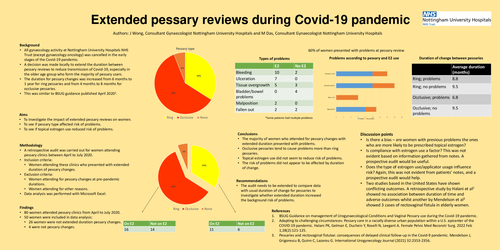
Extended pessary reviews during Covid-19 pandemic
Authors: J Wong, Consultant Gynaecologist Nottingham University Hospitals and M Das, Consultant Gynaecologist Nottingham University Hospitals
Background
•All gynaecology activity at Nottingham University Hospitals NHS Trust (except gynaecology oncology) was cancelled in the early stages of the Covid-19 pandemic.
•A decision was made locally to extend the duration between pessary reviews to reduce transmission of Covid-19, especially in the older age group who form the majority of pessary users.
•The duration for pessary changes was increased from 6 months to 1 year for ring pessaries and from 4 months to 8 months for occlusive pessaries.
•This was similar to BSUG guidance published April 20201.
Aims
•To investigate the impact of extended pessary reviews on women.
•To see if pessary type affected risk of problems.
•To see if topical estrogen use reduced risk of problems.
Methodology
•A retrospective audit was carried out for women attending pessary clinics between April to July 2020.
•Inclusion criteria:
•Women attending these clinics who presented with extended duration of pessary changes.
•Exclusion criteria:
•Women attending for pessary changes at pre-pandemic durations.
•Women attending for other reasons.
•Data analysis was performed with Microsoft Excel.
Findings
•80 women attended pessary clinics from April to July 2020.
•50 women were included in data analysis:
•26 women were not extended duration pessary changes.
•4 were not pessary changes.
Conclusions
•The majority of women who attended for pessary changes with extended duration presented with problems.
•Occlusive pessaries tend to cause problems more than ring pessaries.
•Topical estrogen use did not seem to reduce risk of problems.
•The risk of problems did not appear to be affected by duration of change.
Discussion points
•Is there a bias – are women with previous problems the ones who are more likely to be prescribed topical estrogen?
•Is compliance with estrogen use a factor? This was not evident based on information gathered from notes. A prospective audit would be useful.
•Does the type of estrogen use/applicator usage influence risk? Again, this was not evident from patients’ notes, and a prospective audit would help.
•Two studies based in the United States have shown conflicting outcomes. A retrospective study by Halani et al2 showed no association between duration of time and adverse outcomes whilst another by Mendelson et al3 showed 3 cases of rectovaginal fistula in elderly women.
Recommendations
•The audit needs to be extended to compare data with usual duration of change for pessaries to investigate whether extended duration increased the background risk of problems.
References
1.BSUG Guidance on management of Urogynaecological Conditions and Vaginal Pessary use during the Covid-19 pandemic.
2.Adapting to challenging circumstances: Pessary care in a racially diverse urban population within a U.S. epicenter of the COVID-19 pandemic. Halani PK, Gelman E, Duchein Y, Roselli N, Leegant A. Female Pelvic Med Reconstr Surg. 2022 Feb 1;28(2):121-125.
3.Pessaries and rectovaginal fistulae: consequences of delayed clinical follow-up in the Covid-9 pandemic. Mendelson J, Grigorescu B, Quinn C, Lazarou G. International Urogynecology Journal (2021) 32:2353-2356.