1,830 posters, 67 videos, 75 audios, 29 topics, 22 sessions, 4,727 authors, 1,697 institutions
ePostersLive by SciGen Technologies S.A. All rights reserved.
RCOG World Congress 2023
June 12 - 14, 2023 | London, UK

EP.0955
Laparoscopic total hysterectomy: experience of the Aziza Othmana hospital in Tunisia
Poster Presenter
Part of Topic
Benign Gynaecology
Title: Laparoscopic total hysterectomy: experience of the Aziza Othmana hospital in Tunisia
Authors: Mohamed Rebei, Zeineb Zemni, Meriem Ouederni, Mohamed Frikha, Marouen Braham, Anis Fadhlaoui, Moez Kdous, Monia Ferchiw
Obstetrics and Gynecology Department- Aziza Othmana Hospital
University Tunis Elmanar, Faculty of medicine
Introduction
Hysterectomy is the most frequently performed surgical procedure in gynecology for women apart from pregnancy. If surgical indications in benign pathology are currently well codified, the choice of the approach is still a subject of controversy. This study sets sight on the indications of laparoscopic hysterectomy and its position in our practice and aims to evaluate the short and long term complications as well.
Methods
We conducted a retrospective descriptive cohort study.
The study was carried out in the department of obstetrics ans gynecology of the hospital of Aziza Othmana, Tunis over a period of 3 years extending from January 2020 to January 2023. Our work included all patients who underwent laparoscopic total hysterectomy.
The data was collected from the patients' medical records.
Results
• The study included 138 patients.
• The average age of our patients was 53 years. The majority of patients were in the peri-menopausal period, 21.1% were post-menopausal. History of laparotomy was found in 18% of patients.
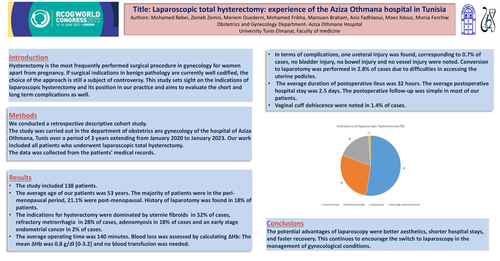
• The indications for hysterectomy were dominated by uternie fibroids in 52% of cases, refractory metrorrhagia in 28% of cases, adenomyosis in 18% of cases and an early stage endometrial cancer in 2% of cases.
• The average operating time was 140 minutes. Blood loss was assessed by calculating ΔHb: The mean ΔHb was 0.8 g/dl [0-3.2] and no blood transfusion was needed.
• In terms of complications, one ureteral injury was found, corresponding to 0.7% of cases, no bladder injury, no bowel injury and no vessel injury were noted. Conversion to laparotomy was performed in 2.8% of cases due to difficulties in accessing the uterine pedicles.
• The average duration of postoperative ileus was 32 hours. The average postoperative hospital stay was 2.5 days. The postoperative follow-up was simple in most of our patients.
• Vaginal cuff dehiscence were noted in 1.4% of cases.
Conclusions
• The potential advantages of laparoscopy were better aesthetics, shorter hospital stays, and faster recovery. This continues to encourage the switch to laparoscopy in the management of gynecological conditions.