1,830 posters, 67 videos, 75 audios, 29 topics, 22 sessions, 4,727 authors, 1,697 institutions
ePostersLive by SciGen Technologies S.A. All rights reserved.
RCOG World Congress 2023
June 12 - 14, 2023 | London, UK

EP.0952
Treatment of Heavy menstrual bleeding in Secondary Care: a retrospective cohort study
Poster Presenter
Part of Topic
Benign Gynaecology
Treatment of Heavy Menstrual Bleeding in Secondary Care: a retrospective cohort study of 50 patients referred to a multi-site London university teaching hospital.
Nicholas Tan, Jessica Thomas, Katherine Barrett, Shuchen Zhang, Magdy Nawar
London North West University Healthcare NHS Trust, London, United Kingdom
Introduction
Heavy menstrual bleeding (HMB), is one of the most common disorders referred to gynaecology services. Treatment options are broadly split into hormonal (Levonorgestrel intrauterine system (LNG-IUS), oral progesterone or combined contraceptive) and non-hormonal pharmacological (Tranexamic acid), and surgical (Transcervical resection of fibroids/polyps, endometrial ablation, myomectomy, hysterectomy).
Objective
The aim of this study is to compare the outcomes of different treatments for HMB in patients referred to a multi-site London university teaching hospital, including first line treatments initiated in primary care.
Design
This retrospective cohort study was designed using an analytical and observational framework.
Method
This study included 50 patients that were referred to the general gynaecology clinic at London North West University Healthcare NHS Trust for pre-dominant HMB over a six-month period between 1st January 2022 and 1st July 2022. Clinics within that period were selected using simple randomization with a randomizer tool. Patients were identified using the electronic records system. Patient characteristics including age, ultrasound findings including fibroids >3cm, and co-existing symptoms were collected. The primary outcomes were measured by determining whether second- and third-line treatments were needed. Descriptive statistics were used for data analysis.
Results
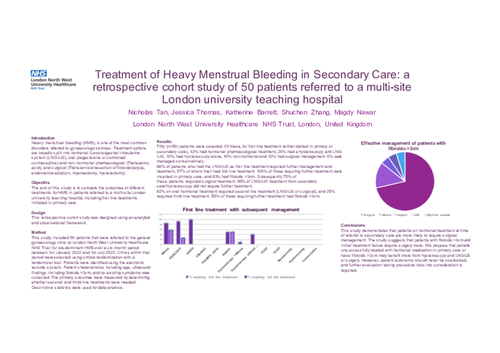
Fifty (n=50) patients were selected. Of these, for first line treatment (either started in primary or secondary care), 42% had hormonal pharmacological treatment, 20% had a hysteroscopy and LNG-IUS, 10% had hysteroscopy alone, 10% non-hormonal and 10% had surgical management. 6% were managed conservatively.
86% of patients who had the LNG-IUS as first line treatment required further management and treatment, 57% of whom then had 3rd line treatment. 100% of those requiring further treatment were inserted in primary care, and 83% had fibroids >3cm. Subsequently 75% of
these patients required surgical treatment. 90% of LNG-IUS treatment from secondary care/hysteroscopy did not require further treatment.
92% on oral hormonal treatment required second line treatment (LNG-IUS or surgical), and 25% required third line treatment. 55% of those requiring further treatment had fibroids >3cm.
Conclusions
This study demonstrates that patients on hormonal treatment at time of referral to secondary care are more likely to require surgical management. The study suggests that patients with fibroids >3cm and initial treatment failure require surgery more. We propose that patients unsuccessfully treated with hormonal medication in primary care or have fibroids >3cm may benefit more from hysteroscopy and LNG-IUS or surgery. However, patient autonomy should never be overlooked, and further evaluation taking procedure risks into consideration is required.