1,830 posters, 67 videos, 75 audios, 29 topics, 22 sessions, 4,727 authors, 1,697 institutions
ePostersLive by SciGen Technologies S.A. All rights reserved.
RCOG World Congress 2023
June 12 - 14, 2023 | London, UK

EP.0940
Profile and Short-Term Outcomes among Women with Malignant Ovarian Cancers in Maryland
Part of Topic
Gynae Oncology
Profile and Short-Term Outcomes among Women with Malignant Ovarian Cancers in Maryland
Oluwasegun Akinyemi, MD, MPH, Terhas Asfiha Weldeslase, MD, Irene Moridi MD, Deborah Makanjuola MD, Nkemdirim Ugochukwu BS , Eunice Odusanya BS, Mojisola Fasokun MD, Colon-Santos Lynne , MD, Luo Guoyang, MD, Ph.D.
PURPOSE / OBJECTIVES
Ovarian malignancies remain one of the most typical causes of cancer-specific mortality among women in the United States.
About 20,000 women are projected to be diagnosed with the disease in 2023 and more than 13,000 women are expected to die from the condition in the same year.
A woman's risk of ovarian cancer is 1.3%, with her lifetime risk of dying from the disease reported at 0.9%.
OBJECTIVE
Social Determinants of Health (SDOHs) play an essential role in the incidence, diagnosis, and overall survival of cancer patients in the United States.
To determine the independent association between patient's race/ethnicity and socioeconomic factors (insurance type, median household income, and neighborhood socioeconomic deprivation) and short-term outcomes of a malignant ovarian neoplasm following admission.
MATERIAL & METHODS
We utilized the Maryland State Inpatient Sample database (SID 2018-2020) to conduct a retrospective analysis of women with malignant ovarian cancers.
We determined the influence of SDOHs on 30-day in-hospital mortality, hospital length of stay, and discharge disposition.
In addition, we included women's age, preexisting comorbidities, and treatment modalities in the multivariate analysis.
RESULTS
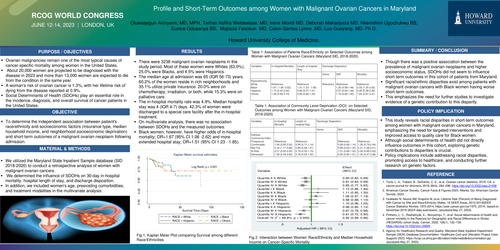
There were 3238 malignant ovarian neoplasms in the study period. Most of these women were Whites (63.0%), 25.0% were Blacks, and 4.5% were Hispanics.
The median age at admission was 65 (IQR 56-73) years. 60.2% of the women reside in rich neighborhoods and 35.1% utilize private insurance. 20.0% were on chemotherapy, irradiation, or both, while 15.3% were on palliative care.
The in-hospital mortality rate was 4.9%. Median hospital stay was 4 (IQR 4-7) days. 42.3% of women were discharged to a special care facility after the in-hospital treatment.
On multivariate analysis, there was no association between SDOHs and the measured outcomes.
Black women, however, have higher odds of in-hospital mortality; OR=1.67 (95% CI 1.06 -2.62) and more extended hospital stay, OR=1.51 (95% CI 1.23 - 1.85).
SUMMARY / CONCLUSION
Though there was a positive association between the prevalence of malignant ovarian neoplasms and higher socioeconomic status, SDOHs did not seem to influence short term outcomes in this cohort of patients from Maryland.
Significant racial/ethnic disparities exist among patients with malignant ovarian cancers with Black women having worse short-term outcomes.
This emphasizes the need for further studies to investigate evidence of a genetic contribution to this disparity.
POLICY IMPLICATION
This study reveals racial disparities in short-term outcomes among women with malignant ovarian cancers in Maryland, emphasizing the need for targeted interventions and improved access to quality care for Black women.
Although social determinants of health did not directly influence outcomes in this cohort, exploring genetic contributions to disparities is crucial.
Policy implications include addressing racial disparities, promoting access to healthcare, and conducting further research on genetic factors.
REFERENCE
Torre, L. A., Trabert, B., DeSantis, C. E., et.al. Ovarian cancer statistics, 2018. CA: a cancer journal for clinicians, 2018; 68(4), 284–296. https://doi.org/10.3322/caac.21456
American Cancer Society. Cancer Facts & Figures 2023. Atlanta, Ga: American Cancer Society; 2023.
Howlader N, Noone AM, Krapcho M, et.al. Lifetime Risk (Percent) of Being Diagnosed with Cancer by Site and Race/Ethnicity; Males, 18 SEER Areas, 2012-2014SEER Cancer Statistics Review, 1975-2014, https://seer.cancer.gov/csr/1975_2014/, based on November 2016 SEER data submission, (accessed May 27, 2023)
Pinheiro, L. C., Reshetnyak, E., Akinyemiju, T., et.al. Social determinants of health and cancer mortality in the Reasons for Geographic and Racial Differences in Stroke (REGARDS) cohort study. Cancer, 2022; 128(1), 122–130. https://doi.org/10.1002/cncr.33894
Agency for Healthcare Research and Quality. Maryland State Inpatient Department Sample (SIDS) Database Documentation. Healthcare Cost and Utilization Project (User Support) 2023. https://hcup-us.ahrq.gov/db/nation/neds/nedsdbdocumentation.jsp (accessed May 27, 2023)