1,830 posters, 67 videos, 75 audios, 29 topics, 22 sessions, 4,727 authors, 1,697 institutions
ePostersLive by SciGen Technologies S.A. All rights reserved.
RCOG World Congress 2023
June 12 - 14, 2023 | London, UK

EP.0267
Identification of targetable genetic alterations and therapeutic approaches for uterine leiomyosarcoma
Poster Presenter
Part of Topic
Gynae Oncology
Identification of targetable genetic alterations and therapeutic approaches for uterine leiomyosarcoma
Shalayna Sakaria, Dr. Victoria Chamberlain, Prof. John Lunec
Introduction
Uterine leiomyosarcomas (uLMS) are rare, aggressive cancers that often recur despite surgical removal and adjuvant gemcitabine-docetaxel chemotherapy (1-3). Thus, there is an urgency to define novel, targeted approaches that exceed the effectiveness of the current regimen.
We investigated the gemcitabine-docetaxel action at the cellular level to identify possible synergy, and to evaluate the mechanisms by which malignancies may resist its apoptosis-inducing action.
We also gained preliminary insight into an alternative combination, gemcitabine-olaparib on cell lines which varied in p53 mutational status, aiming to prevent repair and perpetuate the damage induced by gemcitabine.
Methods
- Three human leiomyosarcoma cell lines with varying p53 mutational status were cultured and treated: MES-SA (p53WT), SK-UT-1 (p53MUT), and SK-LMS-1 (p53MUT).
- Growth inhibition assays for 72hr of single and combination gemcitabine-docetaxel and gemcitabine-olaparib treatments.
- Dose-response curves were generated, and data were evaluated using Compusyn for synergy quantification, based on Combination Index (CI) calculations.
- Western immunoblot for 6hr treatment of gemcitabine-docetaxel provided insight into cellular mechanisms in the p53 pathway specifically. Probed proteins: p53, phospho-p53, WIP-1, PARP-1, MDM2, p21 and PUMA.
- Statistical analyses were conducted using GraphPad PRISM 6.
Results
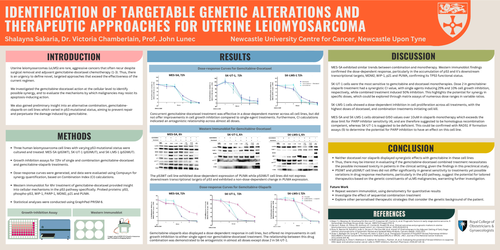
Concurrent gemcitabine-docetaxel treatment was effective in a dose-dependent manner across all cell lines, but did not offer improvements in cell growth inhibition compared to single-agent treatments. Furthermore, CI calculations indicated an antagonistic relationship across almost all doses.
The p53WT cell line exhibited dose-dependent expression of PUMA while p53MUT cell lines did not express downstream transcriptional targets of p53 and exhibited a non-dose-dependent change in PUMA expression.
Gemcitabine-olaparib also displayed a dose-dependent response in cell lines, but offered no improvements in cell growth inhibition to either single-agent nor gemcitabine-docetaxel treatment. The relationship between this drug combination was demonstrated to be antagonistic in almost all doses except dose 2 in SK-UT-1.
Discussion
MES-SA exhibited similar trends between combination and monotherapy. Western immunoblot findings confirmed the dose-dependent response, particularly in the accumulation of p53 and it's downstream transcriptional targets; MDM2, WIP-1, p21 and PUMA, confirming its TP53 functional status.
SK-UT-1 cells were the most sensitive to gemcitabine and docetaxel monotherapies. Dose 2 in gemcitabine- olaparib treatment had a synergistic CI value, with single agents inducing 25% and 10% cell growth inhibition, respectively, while combined treatment induced 50% inhibition. This highlights the potential for synergy in specific doses, which could be explored through matrix assays of numerous dose ranges in variable ratios.
SK-LMS-1 cells showed a dose-dependent inhibition in cell proliferation across all treatments, with the highest doses of docetaxel, and combination treatments initiating cell kill.
MES-SA and SK-LMS-1 cells obtained GI50 values over 10uM in olaparib monotherapy which exceeds the dose limit for PARP inhibitor sensitivity (4), and are therefore suggested to be homologous recombination competent, whereas SK-UT-1 is suggested to be deficient. This could be confirmed with RAD51 IF formation assays (5) to determine the potential for PARP inhibition to have an effect on this cell line.
Conclusion
Neither docetaxel nor olaparib displayed synergistic effects with gemcitabine in these cell lines
Thus, there may be interest in evaluating if the gemcitabine-docetaxel combined treatment necessitates the possible increased toxicity in patients in the clinical setting, given the findings in this preclinical study. P53WT and p53MUT cell lines did not differ significantly in general sensitivity to treatments yet possible variations in drug response mechanisms, particularly in the p53 pathway, suggest the potential for tailored therapeutics based on the genetic constituents of uLMS malignancies, warranting further investigation.
Future Work
- Repeat western immunoblot, using densitometry for quantitative results
- Investigate the effect of sequential combination treatment
- Explore other personalised therapeutic strategies that consider the genetic background of the patient
References
1.Major FJ, Blessing JA, Silverberg SG, Morrow CP, Creasman WT, Currie JL, et al. Prognostic factors in early-stage uterine sarcoma. A Gynecologic Oncology Group study. Cancer. 1993;71(4 Suppl):1702-9.
2.Garcia C, Kubat JS, Fulton RS, Anthony AT, Combs M, Powell CB, et al. Clinical outcomes and prognostic markers in uterine leiomyosarcoma: a population-based cohort. Int J Gynecol Cancer. 2015;25(4):622-8.
3.Rizzo A, Nannini M, Astolfi A, Indio V, De Iaco P, Perrone AM, et al. Impact of Chemotherapy in the Adjuvant Setting of Early Stage Uterine Leiomyosarcoma: A Systematic Review and Updated Meta-Analysis. Cancers (Basel). 2020;12(7).
4.Drew Y, Mulligan EA, Vong W-T, Thomas HD, Kahn S, Kyle S, et al. Therapeutic Potential of Poly(ADP-ribose) Polymerase Inhibitor AG014699 in Human Cancers With Mutated or Methylated BRCA1 or BRCA2. JNCI: Journal of the National Cancer Institute. 2011;103(4):334-46.
5.Mukhopadhyay A, Drew Y, Matheson E, Salehan M, Gentles L, Pachter JA, et al. Evaluating the potential of kinase inhibitors to suppress DNA repair and sensitise ovarian cancer cells to PARP inhibitors. Biochem Pharmacol. 2019;167:125-32.