1,830 posters, 67 videos, 75 audios, 29 topics, 22 sessions, 4,727 authors, 1,697 institutions
ePostersLive by SciGen Technologies S.A. All rights reserved.
RCOG World Congress 2023
June 12 - 14, 2023 | London, UK

EP.0939
Cervical cancer during Covid pandemic: are patients presenting with more advanced tumours?
Poster Presenter
Authors
Affiliations
Oxford Gynaecological Cancer Centre, Churchill Hospital, Oxford University Hospitals Foundation Trust, Cellular pathology department, John Radcliffe Hospital, , Oxford University Hospitals Foundation Trust, Clinical Oncology department, Churchill Hospital, Oxford University Hospitals Foundation Trust,
Part of Topic
Gynae Oncology
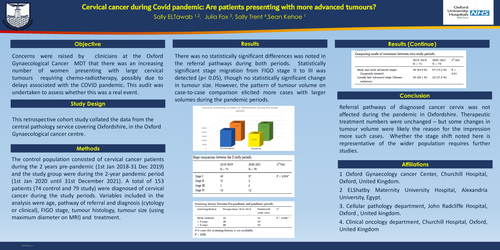
Objectives: Concerns were raised by clinicians at the Oxford Gynaecological Cancer MDT that there was an increasing number of women presenting with large cervical tumours requiring chemo-radiotherapy, possibly due to delays associated with the COVID pandemic. This audit was undertaken to assess whether this was a real event.
Study design: This retrospective cohort study collated the data from the central pathology service covering Oxfordshire, in the Oxford Gynaecological cancer centre.
Methods : The control population consisted of patients treated during the 2 years pre-pandemic (1st Jan 2018-31 Dec 2019) and the study group the 2-year pandemic period (1st Jan 2020 until 31st December 2021). A total of 153 patients (74 control and 79 study) were diagnosed of cervical cancer during the study period. Variables included in the analysis were age, pathway of referral and diagnosis (cytology or clinical), FIGO stage, tumour histology, tumour size (using maximum diameter on MRI) and treatment. Student’s t-test was used for continuous and discrete variables, respectively. The X2 test was used for the statistical analysis of proportions.
Results There was no statistically significant differences was noted in the referral pathways during both periods. Statistically significant stage migration from FIGO stage II to III was detected (p< 0.05), though no statistically significant change in tumour size. However, the pattern of tumour volume on case-to-case comparison elicited more cases with larger volumes during the pandemic periods.
Conclusions: Referral pathways of diagnosed cancer cervix was not affected during the pandemic in Oxfordshire. Therapeutic treatment numbers were unchanged – but some changes in tumour volume were likely the reason for the impression more such cases. Whether the stage shift noted here is representative of the wider population requires further studies.