1,830 posters, 67 videos, 75 audios, 29 topics, 22 sessions, 4,727 authors, 1,697 institutions
ePostersLive by SciGen Technologies S.A. All rights reserved.
RCOG World Congress 2023
June 12 - 14, 2023 | London, UK

EP.0933
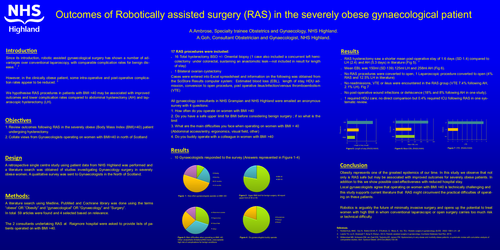
Outcomes of Robotically assisted surgery (RAS) in the severely obese gynaecological patient
Poster Presenter
Authors
Affiliations
Part of Topic
Hot Topics (Emerging research/issues) in Gynaecology
Outcomes of Robotically assisted surgery (RAS) in the severely obese gynaecological patient
A.Ambrose, Specialty trainee Obstetrics and Gynaecology, NHS Highland.
A.Goh, Consultant Obstetrician and Gynaecologist, NHS Highland.
Introduction
Since its introduction, robotic assisted gynaecological surgery has shown a number of advantages over conventional laparoscopy, with comparable complication rates for benign disease.1 ,2
However, in the clinically obese patient, some intra-operative and post-operative complication rates appear to be reduced. 3
We hypothesise RAS procedures in patients with BMI >40 may be associated with improved outcomes and lower complication rates compared to abdominal hysterectomy (AH) and laparoscopic hysterectomy (LH).
Objectives
1. Review outcomes following RAS in the severely obese (Body Mass Index (BMI)>40) patient undergoing hysterectomy.
2. Collate views from Gynaecologists operating on women with BMI>40 in north of Scotland
Design
A retrospective single centre study using patient data from NHS Highland was performed and a literature search was obtained of studies investigating Gynaecology surgery in severely obese women. A qualitative survey was sent to Gynaecologists in the North of Scotland.
Methods:
A literature search using Medline, PubMed and Cochrane library was done using the terms “obese” OR ”Obesity” and “gynaecological” OR “Gynaecology” and “Surgery”.
In total 59 articles were found and 4 selected based on relevance.
The 2 consultants undertaking RAS at Raigmore hospital were asked to provide lists of patients operated on with BMI >40.
17 RAS procedures were included:
- 16 Total hysterectomy BSO +/- Omental biopsy (1 case also included a concurrent left hemicolectomy under colorectal, sustaining an anastomotic leak—not included in result for length of stay)
- 1 Bilateral ovarian cystectomy
Cases were entered into Excel spreadsheet and information on the following was obtained from the SciStore Results computer system: Estimated blood loss (EBL), length of stay, HDU admission, conversion to open procedure, post operative ileus/infection/venous thromboembolism (VTE)
All gynaecology consultants in NHS Grampian and NHS Highland were emailed an anonymous survey with 4 questions:
1. How often do you operate on women with BMI >40
2. Do you have a safe upper limit for BMI before considering benign surgery ; if so what is the limit
3. What are the main difficulties you face when operating on women with BMI > 40
(Abdominal access/entry, ergonomics, visual field, other)
4. Do you buddy operate with a colleague in women with BMI >40
Results
- 10 Gynaecologists responded to the survey (Answers represented in Figure 1-4)
- RAS hysterectomy saw a shorter mean post-operative stay of 1.6 days (SD 1.4) compared to LH (2.4) and AH (5.3 days) in literature (Fig 5). 3
-
- Mean EBL was 150ml (SD 139) 125ml LH and 258ml AH (Fig 6).
- No RAS procedures were converted to open, 1 Laparoscopic procedure converted to open (4% RAS and 12.5% LH in literature)
- No readmissions, VTE or ileus were encountered in the RAS group (VTE 7.4% following AH, 2.1% LH). Fig 7
- No post-operative wound infections or dehiscence (18% and 8% following AH in one study).
- 1 required HDU care; no direct comparison but 0.4% required ICU following RAS in one systematic review.
Conclusion
Obesity represents one of the greatest epidemics of our time. In this study we observe that not only is RAS safe but may be associated with improved outcomes for severely obese patients. In addition to this we show possible cost-effectiveness with reduced hospital stay.
Local gynaecologists agree that operating on women with BMI >40 is technically challenging and
this study supports current literature that RAS might circumvent the practical difficulties of operating on these patients.
Robotics is arguably the future of minimally invasive surgery and opens up the potential to treat women with high BMI in whom conventional laparoscopic or open surgery carries too much risk or technical difficulty.