1,830 posters, 67 videos, 75 audios, 29 topics, 22 sessions, 4,727 authors, 1,697 institutions
ePostersLive by SciGen Technologies S.A. All rights reserved.
RCOG World Congress 2023
June 12 - 14, 2023 | London, UK

EP.0924
Efficacy, safety and acceptability of a vaginal tampon for biospecimen collection samples
Poster Presenter
Part of Topic
Hot Topics (Emerging research/issues) in Gynaecology
Efficacy, safety and acceptability of a vaginal tampon for biospecimen sample collection
Stephanie Girgis, Florence Turner, Simon Powell, Ellen Palmer, Nicola Tempest,
Department of Women’s and Children’s Health, Liverpool Women’s Hospital, University of Liverpool
BACKGROUND- Women’s services have poor attendance. Fear and embarrassment surrounding gynaecological health remain prevalent. Numerous long term sequalae can result from lack of gynaecological care include pelvic inflammatory disease, infertility and malignancy. Although the menstrual tampon as a biospecimen collection device has been demonstrated to be able to identify various gynaecological abnormalities, currently, possibly due to its novelty and lack of information on validity, they are not routinely used.
OBJECTIVES- Determine if self-collected vaginal tampons, as biospecimen collection tools, are comparable to current gold-standard methods in their efficacy, safety and acceptability.
METHODS- A Systematic review was conducted following PRISMA guidelines and prospectively registered with PROSPERO (CRD42022374857). PubMed, MEDLINE, Cochrane Library, Scopus, and Web of Science were searched for eligible studies. All primary studies reporting the acceptability, efficacy or safety of vaginal tampons as a biospecimen collection device in comparison to other conventional methods of collection were included.
RESULTS-
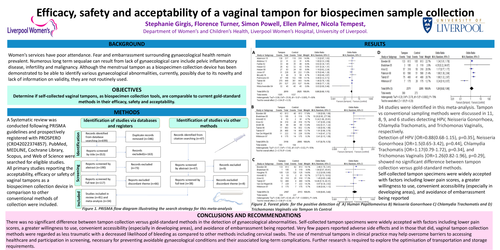
34 studies were identified in this meta-analysis. Tampon vs conventional sampling methods were discussed in 11, 8, 9, and 6 studies detecting HPV, Neisseria Gonorrhoea, Chlamydia Trachomatis, and Trichomonas Vaginalis, respectively. Detection of HPV [OR=0.88(0.68-1.15), p=0.35], Neisseria Gonorrhoea [OR=1.5(0.65-3.42), p=0.44], Chlamydia Trachomatis [OR=1.17(0.79-1.72), p=0.34], and Trichomonas Vaginalis [OR=1.26(0.82-1.96), p=0.29], showed no significant difference between tampon collection versus gold-standard methods. Self-collected tampon specimens were widely accepted with factors including lower pain scores, a greater willingness to use, convenient accessibility (especially in developing areas), and avoidance of embarrassment being reported
CONCLUSIONS AND RECOMMENDATIONS- There was no significant difference between tampon collection versus gold-standard method in the detection of gynaecological abnormalities. Self-collected tampon specimens were widely accepted with factors including lower pain scores, a greater willingness to use, convenient accessibility (especially in developing areas), and avoidance of embarrassment being reported. Very few papers reported adverse side effects and in those that did, vaginal tampon collection methods were regarded as less traumatic with a decreased likelihood of bleeding as compared to other methods including cervical swabs. The use of menstrual tampons in clinical practice may help overcome barriers to accessing healthcare and participation in screening, necessary for preventing avoidable gynaecological conditions and their associated long-term complications. Further research is required to explore the optimisation of transportation and storage requirements.