1,830 posters, 67 videos, 75 audios, 29 topics, 22 sessions, 4,727 authors, 1,697 institutions
ePostersLive by SciGen Technologies S.A. All rights reserved.
RCOG World Congress 2023
June 12 - 14, 2023 | London, UK

EP.0091
What outcomes are important to families following stillbirth? A qualitative systematic review
Poster Presenter
Authors
Emma Stead, Danya Bakhbakhi, Anna Davies, Christy Burden, Abigail Fraser, Dimitris Siassakos, Abi Merriel, Clare Shakespeare, Lisa Hinton, Collaborative Group
Affiliations
University College London, Liverpool University Hospitals Foundation Trust, University of Bristol, University of Liverpool, University of Cambridge
Part of Topic
Hot Topics (Emerging research/issues) in Obstetrics
Audio
What outcomes are important to families following a stillbirth? A qualitative systematic review
Introduction
Estimates suggest that each year, stillbirth affects 2 million families worldwide (1,2). Studies have demonstrated that the care families receive following stillbirth is inadequate and is often variable between care settings (3). This is perhaps because interventions offered to families who are affected by stillbirth have a limited evidence base (4).
Objective
To use qualitative research to identify what outcomes related to care are important families with a lived experience of stillbirth. This can then inform the development of a core outcome set for future stillbirth care research.
Methods
We systematically searched 7 electronic databases. 15,495 papers were screened. Studies were included if they has qualitative methodology and reported outcomes of stillbirth. We excluded papers that included pregnancy loss <20 weeks and neonatal death, non-English language. 74 studies were included in this review. These papers were then read by 2 independent reviewers and coded using the software Nvivo. The two independent reviewer then engaged in iterative discussion throughout extraction and analysis. The codes were refined and grouped into broader outcome categories.
Results
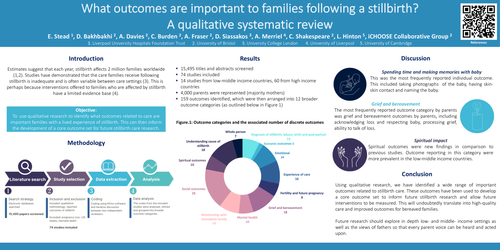
This was he most frequently reported individual outcome. This included taking photographs of the baby, having skin-skin contact and naming the baby.
Grief and bereavement
The most frequently reported outcome category by parents was grief and bereavement outcomes by parents, including acknowledging loss and respecting baby, processing grief, ability to talk of loss.
Spiritual impact
Spiritual outcomes were new findings in comparison to previous studies. Outcome reporting in this category were more prevalent in the low-middle income countries.
Conclusion
Using qualitative research, we have identified a wide range of important outcomes related to stillbirth care. These outcomes have been used to develop a core outcome set to inform future stillbirth research and allow future interventions to be measured. This will undoubtedly translate into high-quality care and improved outcomes for bereaved families.
Future research should explore in depth low- and middle- income settings as well as the views of fathers so that every parent voice can be heard and acted upon.