1,830 posters, 67 videos, 75 audios, 29 topics, 22 sessions, 4,727 authors, 1,697 institutions
ePostersLive by SciGen Technologies S.A. All rights reserved.
RCOG World Congress 2023
June 12 - 14, 2023 | London, UK

EP.0022
Risk factors of stillbirth in multiple compared to singleton pregnancies
Poster Presenter
Authors
Alicia Martínez-Varea, Josep Domenech, Smriti Prasad, Asma Khalil
Affiliations
Department of Obstetrics and Gynaecology. La Fe University and Polytechnic Hospital, Department of Economics and Social Sciences, Universitat Politècnica de València, FMU Research Clinical Fellow. St George's University Hospital NHS Foundation Trust, Fetal Medicine Unit, St George’s Hospital
Part of Topic
Hot Topics (Emerging research/issues) in Obstetrics
Risk factors of stillbirth in multiple compared to singleton pregnancies
Alicia Martínez-Varea1, Josep Domenech2, SmritiPrasad3, Asma Khalil3
1 Department of Obstetrics and Gynaecology, La Fe University and Polytechnic Hospital, Valencia, Spain.
2 Department of Economics and Social Sciences, UniversitatPolitecnica de Valencia, Valencia, Spain.
3 Fetal Medicine Unit, St George's University Hospitals NHS Foundation Trust, London, United Kingdom.
INTRODUCTION
The objectives of this study were:
MATERIALS AND METHODS
This was a retrospective cohort study of women receiving obstetric care and delivering at St George's Hospital.
Pregnancies from June 1999-December 2022 were included. Exclusion criteria included deficient data regarding gestational age at birth, miscarriage or livebirth ≤23+6 weeks, and termination of pregnancy. The four study groups were early and late stillbirths in singleton and multiple pregnancies. Logistic regression analysis assessed association between risk factors and pregnancy outcomes.
RESULTS
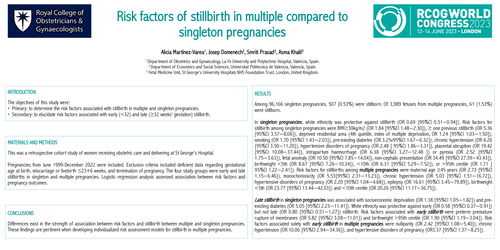
Among 96,166 singleton pregnancies, 507 (0.53%) were stillborn. Of 3,989 fetuses from multiple pregnancies, 61 (1.53%) were stillborn.
In singleton pregnancies, white ethnicity was protective against stillbirth (OR 0.69 [95%CI 0.51−0.94]). Risk factors forstillbirth among singletonpregnancies were BMI≥30kg/m2 (OR 1.84 [95%CI 1.48−2.30]), ≥ one previous stillbirth (OR 5.36 [95%CI 3.57−8.06]), deprivedresidential area (4th quintile, index of multiple deprivation, OR 1.24 [95%CI 1.03−1.50]), smoking (OR 1.70 [95%CI 1.43−2.03]), pre-existingdiabetes (OR 3.25v95%CI 1.67−6.32]), chronichypertension (OR 6.26 [95%CI 3.50−11.20]), hypertensivedisorders of pregnancy (OR 2.48 [ 95%CI 1.86−3.31]), placentalabruption (OR 19.42 [95%CI 10.08−37.44]), intrapartumhaemorrhage (OR 6.38 [95%CI 3.27−12.48 ]) or pyrexia (OR 2.52 [95%CI 1.75−3.63]), fetal anomaly (OR 10.50 [95%CI 7.85−14.04]), non-cephalicpresentation (OR 34.49 [95%CI 27.39−43.43]), birthweight <5th (OR 8.67 [95%CI 7.26−10.34]), <10th (OR 6.31 [95%CI 5.29−7.52]), or >95th centile(OR 1.71 [ 95%CI 1.22−2.41]). Risk factors for stillbirths among multiple pregnancies were maternal age ≥45 years (OR 2.73 [95%CI 1.15−6.46]), monochorionicity (OR 5.53[95%CI 2.31−13.23]), chronic hypertension (OR 5.03 [95%CI 1.51−16.72]), hypertensive disorders of pregnancy (OR 2.20 [95%CI 1.04−4.68]), epilepsy (OR 16.61 [95%CI 3.45−79.89]), birthweight <5th (OR 23.77 [95%CI 13.44−42.03]) and <10th centile (OR 20.26 [95%CI 11.17−36.75]).
Late stillbirth in singleton pregnancies was associated with socioeconomic deprivation (OR 1.38 [95%CI 1.05−1.82]) and pre-existing diabetes (OR 5.05 [95%CI 2.23−11.41]). White ethnicity was protective against early (OR 0.58 [95%CI 0.37−0.91]) but not late (OR 0.80 [95%CI 0.51−1.27]) stillbirth. Risk factors associated with early stillbirth were preterm premature rupture of membranes (OR 5.82 [95%CI 3.08−11.01]) and birthweight>95th centile (OR 1.90 [95%CI 1.19−3.04]). Risk factors associated solely with early stillbirth in multiple pregnancies were nulliparity(OR 2.42 [95%CI 1.08−5.40]), chronic hypertension (OR 10.06 [95%CI 2.94−34.36]), and hypertensive disorders of pregnancy (OR3.37 [95%CI 1.37−8.25]).
CONCLUSIONS
Differences exist in the strength of association between risk factors and stillbirth between multiple and singleton pregnancies. These findings are pertinent when developing individualized risk assessment models for stillbirth in multiple pregnancies.