1,830 posters, 67 videos, 75 audios, 29 topics, 22 sessions, 4,727 authors, 1,697 institutions
ePostersLive by SciGen Technologies S.A. All rights reserved.
RCOG World Congress 2023
June 12 - 14, 2023 | London, UK

EP.0916
Liberal versus conservative episiotomy practice in vaginal delivery
Poster Presenter
Part of Topic
Labour Ward Management
Liberal versus conservative episiotomy practice in vaginal delivery
Objective:
The aim of our study was to assess our practices regarding episiotomy and consequences of a more restrictive policy to its use.
Design: Retrospective comparative study carried out in a level IIb Tunisian maternity ward, over a period of 6 moths (June 2022-December 2022).
Method: we enrolled all women who gave birth by vaginal route and divided them into 2 groups: Group 1: with episiotomy and Group 2: without episiotomy.
Results
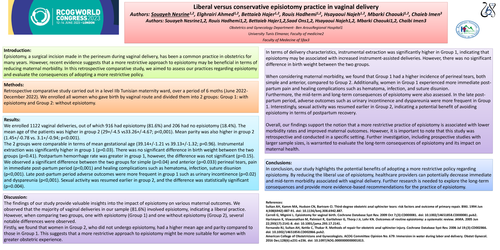
We enrolled 1122 vaginal deliveries, out of which 916 had episiotomy (81.6%) and 206 had no episiotomy (18.4%). The mean age of the patients was higher in group 2 (29+/-4.5 vs33.26+/-4.67; p<0,001). Mean parity was also higher in group 2 (1.45+/-0.78 vs. 3.1+/-0.94; p<0.001).
The 2 groups were comparable in terms of mean gestational age (39.14+/-1.21 vs 39.13+/-1.32; p=0.96). Instrumental extraction was significantly higher in group 1 (p=0.03). There was no significant difference in birth weight between the two groups (p=0.41). Postpartum hemorrhage rate was greater in group 1, however, the difference was not significant (p=0.15). We observed a significant difference between the two groups for simple (p=0.04) and anterior (p=0.033) perineal tears, pain in immediate post-partum period (p<0,001) and healing complications such as hematoma, infection, suture disunion (p<0,001). Late post-partum period adverse outcomes were more frequent in group 1 such as urinary incontinence (p=0.02) and dyspareunia (p<0,001). Sexual activity was resumed earlier in group 2, and the difference was statistically significant (p=0.004).
Conclusion:
Liberal practice of episiotomy is associated with immediate and mid-term morbidity after vaginal delivery. Further investigation is required to evaluate long term consequences.