1,830 posters, 67 videos, 75 audios, 29 topics, 22 sessions, 4,727 authors, 1,697 institutions
ePostersLive by SciGen Technologies S.A. All rights reserved.
RCOG World Congress 2023
June 12 - 14, 2023 | London, UK

EP.0124
Obstetric outcome following Placental Abruption in a Tertiary Hospital
Poster Presenter
Authors
Affiliations
Part of Topic
Labour Ward Management
Obstetric outcome following Placental Abruption in a Tertiary Hospital
Background and Objective
Placental abruption complicates 0.4 -1% of all pregnancies. This increases the maternal morbidity rates and perinatal morbidity and mortality rates significantly.
Aim of this study for analysing the maternal and perinatal outcomes following a confirmed placental abruption.
Methodology
This is a retrospective study conducted at the Royal Brisbane and Womens Hospital, Queensland, Australia between 2012 to 2021. The data was retrieved from the Obstetric Database. All women who were diagnosed to have placental abruption after 23 weeks were included. All other causes of antepartum haemorrhage were excluded.
Results
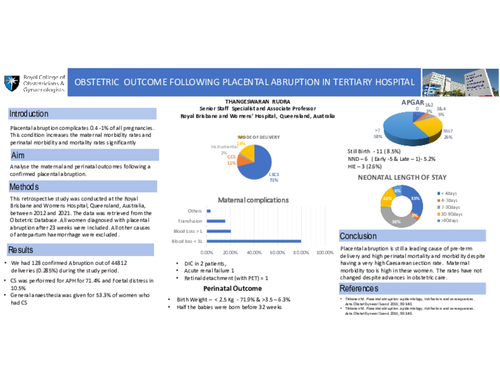
We had 128 confirmed Abruption out of 44812 deliveries (0.285%) during the study period. 74.2% had to be delivered by Caesarean Section of which 3.1% had a Classical CS. Indication for CS was predominantly for APH for 71.4% and 10.5% for Foetal distress. 2.4% delivered needing Instrumental delivery. 22.7% had Post-Partum Haemorrhage. 10.2% had a massive obstetric haemorrhage. 15.6% needed a blood transfusion needed for 15.6%. 2 of them had DIC and 1 had Renal failure.
Perinatal mortality was 13.7%. The baby was stillborn in 11 patients and 6 Neonates died. Three of the babies suffered HIE. Apgar score was greater than 7 in 63.2% of live births and severe. Moderate asphyxia was reported in 3.4% and 5.1% of live births. 107 babies needed admission to Special care or Intensive care. 80.4% of babies were born preterm and 50% of the babies were less than 28 weeks gestation. Low birth weight (<2500g) was reported in 71.2% and 38.3% of babies weighing less than 1500g. Two third of the babies were admitted to special care longer than 4 days.
Conclusions
Placental abruption is still a leading cause of pre-term delivery and high perinatal mortality and morbidity despite having a very high Caesarean section rate. The rates have not changed despite advances in obstetric care since the millennium. This study emphasises the importance of early recognition and prompt delivery.