1,830 posters, 67 videos, 75 audios, 29 topics, 22 sessions, 4,727 authors, 1,697 institutions
ePostersLive by SciGen Technologies S.A. All rights reserved.
RCOG World Congress 2023
June 12 - 14, 2023 | London, UK

EP.0910
Discrepancy Between Preoperative and Postoperative Diagnosis Results in Genital Tuberculosis in Indonesia
Poster Presenter
Authors
Dian Tjahyadi, Sandi Deviano, Bejo Ropii, Tono Djuwantono, Wiryawan Permadi, Ida Parwati
Affiliations
Department of obstetrics and Gynecology of University Padjadjaran, Department of Biomedical Engineering, School of Electrical Engineering and InformaticsDepartment of Biomedical Engineering, School of Electrical Engineering and Informatics, Bandung Institute of Technology, Department of Clinical Pathology, University of Padjadjaran
Part of Topic
Pandemic and impact of Covid/Infectious Diseases
The Discrepancy Between Preoperative and Postoperative Diagnosis Results in Genital Tuberculosis
Introduction
Tuberculosis (TB) which caused by the bacterium Mycobacterium tuberculosis is still a severe infectious disease, with 10 million new cases and 1.6 million deaths worldwide in 2017. The global prevalence burden caused by TB is also relatively high; around 5% (8 million men, 3.2 million women, and 1 million children). TB is ranked 1st out of the 10 main causes of death with the highest mortality rate in the world. Indonesia, as the highest global TB incidence, reaching 8% of the total TB cases in the world in 2017 [1]. Approximately 1/3 of the prevalence of TB cases in the world, or about 4.9 million TB cases, occurs in Southeast Asia [2].
The prevalence of genital TB is approximately 27% (14-41%). There are differences in the majority of genital TB in several countries. Developed countries such as the United States and Italy have a lower prevalence of genital TB in the population of infertile women (1 and 0.8%), while in endemic countries such as India, the majority of genital TB is 26-39%. However, the actual prevalence of genital TB cannot be estimated accurately because Mycobacterium tuberculosis infection does not cause clinically significant symptoms in some cases. TB is endemic in Indonesia, so it is suspected that genital TB often occurs in Indonesian women. If the infection is not recognized early, severe damage to the reproductive organs can result in a permanent inability to conceive [3].
Genital tuberculosis is usually asymptomatic and clinical symptoms do not appear definitively. Therefore, most remain undiagnosed or misdiagnoses in cases of genital TB. In premenopausal women, infertility is a major concern. The incidence of infertility in women with genital TB is about 58-87% [4].Clinical symptoms that appear are usually mild and local, including pelvic pain, menstrual disturbances, and vaginal bleeding [5].
Endometrial TB can imitate the other gynecological conditions. The most effective diagnosis can be achieved through a combination of a high index of suspicion, through clinical initial assessment, and appropriate investigation. Genital TB in women, because it is not contagious, is often overlooked by health care providers. However, the high rates of morbidity and sequelae for affected women are important to consider [5]. Based on the theory and research results described above, the discrepancy between preoperative diagnosis and postoperative anatomic pathology results is interesting to study further.
Material and methods
This study is a descriptive study with a cross-sectional approach to 14 patients diagnosed with genital TB based on the results of anatomical pathology performed after surgery. The study population was taken from the medical records of patients with a diagnosis of genital tuberculosis based on ICD 10 codes A18.1, N74.0, and N74.1 from January 2017 to June 2021.
The research sample was obtained by taking a total sample. The inclusion criteria in this study were patients with genital TB which confirmed through anatomical pathology examinations, and age range of 18-37 years and have a complete medical record data. Exclusion criteria in this study were patients with a diagnosis of genital tuberculosis who did not have complete medical record data and could not be interviewed due to the number could not be contacted or died.
The preoperative diagnosis will be compared with the results of the postoperative anatomic pathology. The pattern of menstrual disorders was assessed using the 2018 FIGO criteria for abnormal uterine bleeding, including frequency, duration, regularity, volume, and intermenstrual bleeding. Researchers conducted interviews with patients with histopathological results in the form of genital tuberculosis, intending to obtain information about the pattern of menstrual disorders and postoperative management of genital tuberculosis.
Results
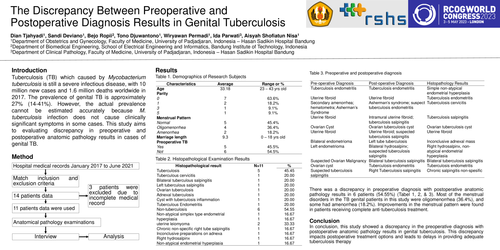
This study was conducted on 14 patients diagnosed with genital tuberculosis at Dr. Hasan Sadikin Hospital Bandung from January 2017 to June 2021. A total of 3 patients were excluded from this study because they had incomplete medical records. The mean age of the patients in this study was 33 years and ranged from 23-43 years. Most of the patients had never given birth (63.6%). Amenorrhea was found in 18.2% of patients in this study. The mean duration of marriage in patients in this study was 9.3 years and ranged from 0-18 years. There are 45.5% of patients had TB lung infection. The sociodemographic and clinical characteristics of the patients are described in Table 1.
Table 2 showed the results of the histopathological examination in this study. A total of 5 patients were detected as having genital TB with variants of tuberculous cervicitis, tuberculous salpingitis, ovarian tuberculosis, adnexal tuberculosis, cysts with tuberculous inflammation, and tuberculous endometritis. However, there were six cases suspected of being non-tuberculosis cases, diagnosed as endometrial hyperplasia, uterine leiomyoma, chronic non-specific right tubal salpingitis, hydrosalpinx, non-atypical endometrial hyperplasia, external endometriosis. This study's discrepancy between preoperative diagnosis and postoperative anatomic pathology results was 54.55%. While table 3 describes the differences in the diagnosis pre-operative, post-operative, and the results of histopathological examination.
Discussion
This study shows a high discrepancy in genital TB patients indicating the need for an excellent diagnostic algorithm. The combination of a complete history, systemic examination, tests to confirm M. tuberculosis infection, and imaging to see the characteristic structural changes are essential for the diagnosis. General analysis to rule out TB foci elsewhere, chest X-ray, erythrocyte sedimentation rate (ESR), and a complete blood count should also be performed. About 10 to 75 percent of patients with genital TB can have abnormal X-rays. However, a normal chest X-ray does not rule out the possibility of genital TB [6].
Some patients were misdiagnosed, leading to a higher time lag for initiating TB treatment. The study by Virenfeldt et al. showed a significant increase in the proportion of seriously ill patients among delayed treatment patients [7].
Genital tuberculosis is often suspected as a malignancy of gynecological condition, such as ovarian cancer, ovarian cysts, or pelvic inflammatory disease. Genital TB patients with infection on the cervix can imitate cervical cancer. In addition, genital TB patients may also be misdiagnosed with acute appendicitis or ectopic pregnancy. Tuberculosis of the vulva and cervix is very difficult to distinguish because the clinical appearance often resembles that of brucellosis, schistosomiasis, tularemia, cervical amoebiasis, sarcoidosis, syphilis, or chancroid [8].
The proportion of drug resistance was higher in cases of treatment failure for extrapulmonary TB, such as genital TB than pulmonary TB. The emergence of multidrug-resistant strains has been reported in FGTB [9]. TB infection of the uterus can alter the endometrial environment and uterine receptivity by causing immune modulation, endocrine disruption, activation of antiphospholipid antibodies, and micro thrombosis leading to recurrent implantation failure, a significant cause of infertility [10]. Most of the menstrual disorders in the TB genital patients in this study were oligomenorrhea (36.4%), and some had amenorrhea (18.2%). Improvements in the menstrual pattern were found in patients receiving complete anti-tuberculosis treatment.
Conclusion
In conclusion, this study showed a discrepancy in the preoperative diagnosis with postoperative anatomic pathology results in genital tuberculosis. This discrepancy impacts postoperative treatment options and leads to delays in providing adequate tuberculosis therapy.
DECLARATIONS
Conflict of interest
The authors declare that they have no conflicts of interest.
Funding details
The author declares no funding resources.
Consent to publish
All authors have read and approved the final manuscript.
Ethics approval statement
The patient has given the informed consent for the study. This study has been registered in Research Registry under the following identification number: researchregistry8551. This study has been approved from the Health Research Ethics Committee of Universitas Padjadjaran under the registration number NOMOR LB.02.01/X.6.5/447/2022
Availability of data and materials
The datasets used and/or analyzed during the current study are available from the corresponding author on reasonable request.
References
1. Organization WH. Global tuberculosis report 2013: World health organization; 2013.
2. Nair N, Wares F, Sahu S. Tuberculosis in the WHO south-east Asia region. SciELO Public Health; 2010. p. 164-.
3. Djuwantono T, Permadi W, Septiani L, Faried A, Halim D, Parwati I. Female genital tuberculosis and infertility: serial cases report in Bandung, Indonesia and literature review. BMC research notes. 2017;10:1-7.
4. Tripathy SN, Tripathy SN. Infertility and pregnancy outcome in female genital tuberculosis. International Journal of Gynecology & Obstetrics. 2002;76(2):159-63.
5. Kashyap B, Srivastava N, Kaur IR, Jhamb R, Singh DK. Diagnostic dilemma in female genital tuberculosis-staining techniques revisited. Iranian journal of reproductive medicine. 2013;11(7):545.
6. Grace GA, Devaleenal DB, Natrajan M. Genital tuberculosis in females. The Indian journal of medical research. 2017;145(4):425.
7. Virenfeldt J, Rudolf F, Camara C, Furtado A, Gomes V, Aaby P, et al. Treatment delay affects clinical severity of tuberculosis: a longitudinal cohort study. BMJ open. 2014;4(6):e004818.
8. Gupta S, Gupta P. Etiopathogenesis, challenges and remedies associated with female genital tuberculosis: potential role of nuclear receptors. Frontiers in immunology. 2020;11:02161.
9. Sethi S, Biswal M, Chatterjee SS, Mewara A, Gupta D, Kumar S, et al. Susceptibility pattern among pulmonary and extrapulmonary isolates of Mycobacterium tuberculosis in north India. Afr J Microbiol Res. 2012;6(15):3696-9.
10. Chowdhury RG, Paine SK, Bhattacharjee B, Chatterjee S. Infestation of endometrium by mycobacterium tuberculosis bacilli-cause of reproductive failure. Al Ameen J Med Sci. 2010;3(4):322-31.
.
Provenance and peer review
Not commissioned, externally peer reviewed.