1,830 posters, 67 videos, 75 audios, 29 topics, 22 sessions, 4,727 authors, 1,697 institutions
ePostersLive by SciGen Technologies S.A. All rights reserved.
RCOG World Congress 2023
June 12 - 14, 2023 | London, UK

EP.0906
INCIDENCE AND OUTCOMES OF PREGNANCIES COMPLICATED BY MAJOR PLACENTA PRAEVIA
Part of Topic
Hot Topics (Emerging research/issues) in Obstetrics
INCIDENCE, MANAGEMENT AND OUTCOMES OF PREGNANCIES COMPLICATED BY MAJOR PLACENTA PRAEVIA AT TYGERBERG HOSPITAL: A TWO-YEAR REVIEW
J Indongo, GS Gebhardt, H Swart
Department of Obstetrics and Gynaecology, Stellenbosch University and Tygerberg Academic Hospital.
Abstract
Introduction
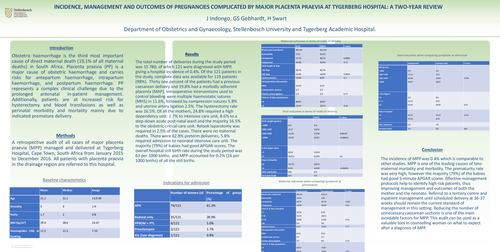
Obstetric haemorrhage is the third most important cause of direct maternal death (19,1% of all maternal deaths) in SA. Placenta praevia (PP) is a major cause of obstetric haemorrhage and carries risks for antepartum haemorrhage, intrapartum haemorrhage, and postpartum haemorrhage. PP represents a complex clinical challenge due to the prolonged antenatal in-patient management. Additionally, patients are at increased risk for hysterectomy and blood transfusions as well as perinatal morbidity and mortality mainly due to indicated premature delivery.
Methods
A retrospective audit of all cases of major placenta praevia (MPP) managed and delivered at Tygerberg Hospital, Cape Town, South Africa from January 2015 to December 2016. All patients with placenta praevia in the drainage region are referred to this hospital.
Results
The total number of deliveries during the study period was 15 780, of which 121 were diagnosed with MPP, giving a hospital incidence of 0.4%. Of the 121 patients in the study, complete data was available for 119 patients (98%). Thirty one percent of the patients had a previous caesarean delivery and 19.8% had a morbidly adherent placenta (MAP). Intraoperative interventions used to control bleeding were multiple haemostatic sutures in 11.6%, followed by compression sutures 5.8% and uterine artery ligation 2.5%. The hysterectomy rate was 16.5%. Of all the mothers, 24.8% required a high dependency unit: 1.7% to intensive care unit, 8.6% to a step-down acute post-natal ward and the majority 16.5% to the obstetric critical care unit. Relook laparotomy was required in 2.5% of the cases. There were no maternal deaths. There were 62.8% preterm deliveries, 5.8% required admission to neonatal intensive care unit. The majority (79%) of babies had good APGAR scores. The overall hospital still birth rate during the study period was 63 per 1000 births, and MPP accounted for 0.2% (16 per 1000 births) of all the still births.
Conclusion
The incidence of MPP was 0.4% which is comparable to other studies. MPP is one of the leading causes of feto-maternal mortality and morbidity. The prematurity rate was very high, however the majority (79%) of the babies had good 5-minute APGAR scores. Effective management protocols help to identify high risk patients, thus improving management and outcomes of both the mother and the neonate.