Loading...

1,830 posters, 67 videos, 75 audios, 29 topics, 22 sessions, 4,727 authors, 1,697 institutions

ePostersLive by SciGen Technologies S.A. All rights reserved.

RCOG World Congress 2023

June 12 - 14, 2023 | London, UK

RCOG World Congress 2023 banner

EP.0902

Robson's Classification System to Optimize Caesarean Rate at Tertiary Care Centre, Pakistan.
Part of Topic

Labour Ward Management

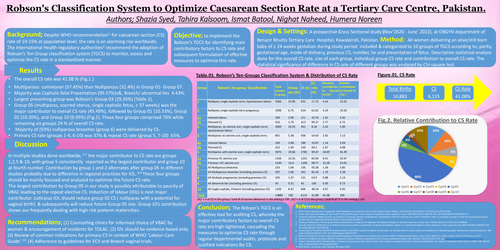
Robson's Classification System to Optimize Caesarean Section Rate at a Tertiary Care Centre, Pakistan.
   Authors; Shazia Syed, TahiraKalsoom, IsmatBatool, NighatNaheed, Humera Noreen


Background; Despite WHO recommendation1, for caesarean section (CS) rate of 10-15% at population level, the rate is on alarming rise worldwide. The international Health regulatory authorities2 recommend the adoption of Robson’s Ten Group classification system (TGCS) to monitor, assess and optimize the CS rate in a standardized manner

Objective; to implement the Robson’s TGCS for identifying main contributory factors to CS rate and subsequent formulation of effective measures to optimize this rate

Study Design & Settings: A prospective Cross Sectional study (Nov’2020 - June’ 2022), at OBGYN department of Benazir Bhutto Tertiary Care  Hospital, Rawalpindi, Pakistan. Method:  All women delivering an alive/still born baby of ≥ 24 weeks gestation during study period  included & categorized to 10 groups of TGCS according to; parity, gestational age, mode of delivery, previous CS, number, lie and presentation of fetus. Descriptive statistical analysis  done for the overall CS rate, size of each group, individual group CS rate and contribution to overall CS rate. The statistical significance of difference in CS rate of different groups was analyzed by Chi-square test.

Results; •The overall CS rate was 41.08 % (Fig.1.)

•Multiparous  commoner (57.45%) than Nulliparous (32.4%) in Group 01- Group 07.
•Majority was Cephalic fetal Presentation (95.57%)v&, Breech/ abnormal lies  4.43%.
•Largest presenting group was Robson’s Group 03 (29.35%) (Table.1).
•Group 05 (multiparas, scarred uterus, single cephalic fetus, ≥ 37 weeks) was the major contributor to overall CS rate (45.49%), followed by Group 01 (10.33%), Group 02 (10.20%), and Group 10 (9.95%) (Fig.2). These four groups comprised 76% while remaining six groups 24 % of overall CS rate.
• Majority of (93%) nulliparous breeches (group 6) were delivered by CS.
•Primary CS rate (groups 1-4, 6-10) was 37% & repeat CS rate (group 5, 7-10)  63%.
 
Discussion; In multiple studies done worldwide, 3-7 the major contributor to CS rate are groups 1,2,5 & 10, with group 5 consistently  reported as the largest contributor and group 10 at fourth number. Contribution by group 1 and 2 alternates after group 05 in different studies probably due to difference in regional practices for IOL. 8-9 These four groups should be mainly focused and analyzed to optimize the future CS rate.

The largest contribution by Group 05 in our study is possibly attributable to paucity of VBAC leading to the repeat elective CS. Induction of labour (IOL) is next major contributor. Judicious IOL should reduce group 02 CS ( nulliparas with a potential for vaginal birth)  & subsequently will reduce future Group 05 size. Group 10’s contribution shows our frequently dealing with high risk preterm maternities.

Recommendations; (1) Counselling clinics for informed choice of VBAC by women & encouragement of residents for TOLAC. (2) IOL should be evidence based only. (3) Review of common indications for primary CS in context of WHO ‘Labour-Care Guide’. 10  (4) Adherence to guidelines for ECV and Breech vaginal trials.

Conclusion; The Robson’s TGCS is an effective tool for auditing CS, whereby the major contributory factors to overall CS rate are high-lightened, cascading the measures to optimize CS rate through regular departmental audits, protocols and justified indications for CS.


References;


1.WHO Human Reproduction Programme. WHO statement on caesarean section rates. Reprod Health  Matters  2015;23(45):149–150.DOI: 10.1016/j.rhm.2015.07.007.


2.Vissar GHA, Ayres-de-Campos D, Barnea ER. FIGO position paper: how to stop the caesarean section epidemic. Lancet 2018;392(10155):1286–87. DOI: 10.1016/S0140-6736(18)32113-5.


3.Jamwal D, Sharma P, Mehta A, Pannu JS. Analysis of caesarean sections using Robson’s classification system in a tertiary care centre in Northern India: an emerging concept to audit the increasing caesarean section rate. Int J Reprod Contracept Obstet Gynecol 2021;10:2281-5.


4.Tanaka K, Mahomed K. The ten group Robson classification: a single center approach identifying strategies to optimize caesarean section rates. Obstet Gynecol Int 2017;2017:5648938.


5.Tura AK, Pijpers O, de Man M, et al. Analysis of caesarean sections using Robson 10-group classification system in a university hospital in eastern Ethiopia: a cross-sectional study. BMJ 2018;8(4):e020520. DOI: 10.1136/bmjopen-2017-020520.


6.Senanayake H, Piccoli M, Valente EP. Implementation of the WHO manual for Robson classification: an example from Sri Lanka using a local database for developing quality improvement recommendations. BMJ Open 2019;9(2):e027317. DOI: 10.1136/bmjopen-2018-027317


7.Pravina P, Ranjana R, Goel N. Cesarean Audit Using Robson Classification at a Tertiary Care Center in Bihar: A Retrospective Study. Cureus 14(3): (March 13, 2022): e23133. DOI 10.7759/cureus.23133


8.Parveen R, Khakwani M, Naz A, Bhatti R. Analysis of Cesarean Sections using Robson’s Ten Group Classification System. Pak J Med Sci. 2021;37(2):567-571. doi: https://doi.org/10.12669/pjms.37.2.3823


9.Varija T, Veerendra KCM, Chandrasekhar T. Analysis of caesarean section rate in tertiary care hospital according to Robson’s 10 groups classification. Int J Reprod Contracept Obstet Gynecol 2018; 7(4):1380-84. DOI: 10.18203/2320-1770.ijrcog20181023.


10.WHO labour care guide; user’s manual, 20 August 2021.


RCOG World Congress 2023 » banner
Copyright © 2015-2026, ePostersLive® SciGen is a registered trademark of SciGen Technologies S.A. Patent pending.

This website and third-party tools we use rely on cookies for the best user experience. By selecting "I agree", you agree to cookie usage as described in our Privacy Policy.