1,830 posters, 67 videos, 75 audios, 29 topics, 22 sessions, 4,727 authors, 1,697 institutions
ePostersLive by SciGen Technologies S.A. All rights reserved.
RCOG World Congress 2023
June 12 - 14, 2023 | London, UK

EP.0901
METHODS of HYSTERECTOMY for BENIGN AETIOLOGY – Trends and Outcomes
Poster Presenter
Authors
Affiliations
Part of Topic
Benign Gynaecology
METHODS OF HYSTERECTOMY FOR BENIGN AETIOLOGY – TRENDS AND OUTCOMES
performed surgical procedure
Selection of the route of hysterectomy for benign causes is influenced by the size and shape of the and uterus; accessibility to the uterus (previous surgery, descent, size) extent of extrauterine disease; the need for concurrent procedures, surgeon training and experience, available hospital technology, devices, and support
Objective
To assess current practice of choosing minimal invasive methods of hysterectomy in a district hospital unit. To evaluate rate of intra-operative and post-operative complications with each method, with reflection on their efficacy towards enhanced recovery
Design
Retrospective analysis of all hysterectomies performed in the unit for benign indications from January2022 to July 2022.
Method
Patient sample was identified from electronic database by audit department. Cases analysed through electronic system and patient case notes
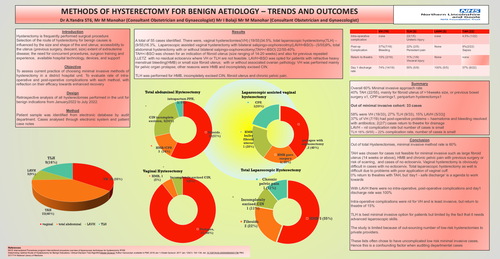
A total of 55 cases identified. There were, vaginal hysterectomies(VH) (19/55)34.5%, total laparoscopic hysterectomy(TLH) –(9/55)16.3%, Laparoscopic assisted vaginal hysterectomy with bilateral salipingo-oophorecotmy(LAVH+BSO)– (5/55)9%, total abdominal hysterectomy with or without bilateral salpingo-oophorecotomy(TAH+/-BSO) 22/55-40%.
TAH+/-BSO was chosen for an indication of fibroid uterus (size ranging of 14-20 weeks) and also for previous repeated LLETZ with no residual ectocervix where VH or TLH are not feasible. LAVH+BSO was opted for patients with refractive heavy menstrual bleeding(HMB) or small size fibroid uterus; with or without associated ovarian pathology. VH was performed mainly for pelvic organ prolapse; other reasons were HMB and incompletely excised CIN.
TLH was performed for HMB, incompletely excised CIN, fibroid uterus and chronic pelvic pain.
Summary
Overall 60% Minimal invasive approach rate
40% TAH (22/55), mainly for fibroid uterus of >14weeks size, or previous bowel surgery x1, CPP scarringx1, peripartum hysterectomyx1
Out of minimal invasive cohort: 33 cases
58% were VH (19/33), 27% TLH (9/33), 15% LAVH (5/33)]
37% of VH (7/19) had post-operative problems – haematoma and bleeding resolved with antibiotics; 2(2/7) cases return to theatre for drainage
LAVH – nil complication rate but number of cases is small
TLH 16% (9/55) – 22% complication rate, number of cases is small
Conclusion
Out of total Hysterectomies, minimal invasive method rate is 60%
TAH was chosen for cases not feasible for minimal invasive such as large fibroid uterus (14 weeks or above), HMB and chronic pelvic pain with previous surgery or risk of scarring, and cases of no ectocervix. Vaginal hysterectomy is obviously difficult in cases with no ectocervix. Total laparoscopic hysterectomy as well is difficult due to problems with poor application of vaginal cuff.
0% return to theatres with TAH, but ‘day1 - safe discharge’ is a agenda to work towards
With LAVH there were no intra-operative, post-operative complications and day1 discharge rate was 100%
Intra-operative complications were nil for VH and is least invasive, but return to theatre of 15%
TLH is best minimal invasive option for patients but limited by the fact that it needs advanced laparoscopic skills.
The study is limited because of out-sourcing number of low-risk hysterectomies to private providers.
These lists often chose to have uncomplicated low risk minimal invasive cases. Hence this is a confounding factor when auditing departmental cases