1,830 posters, 67 videos, 75 audios, 29 topics, 22 sessions, 4,727 authors, 1,697 institutions
ePostersLive by SciGen Technologies S.A. All rights reserved.
RCOG World Congress 2023
June 12 - 14, 2023 | London, UK

EP.0897
TRANSFER: ThReatened preterm birth, Assessment for in utero traNSFER; 22+0-23+6 weeks’ gestation
Poster Presenter
Authors
Affiliations
Part of Topic
Hot Topics (Emerging research/issues) in Obstetrics
Audio
TRANSFER: ThReatened preterm birth, Assessment for in utero transfer; 22+0-23+6 weeks’ gestation
Griffin M J, Smith-Collins A, Hodgetts-Morton V, Hughes T, Magill L, Perry R, Morris K, on behalf of the TRANSFER project collaborative, UK Women’s Health Research Department, Level D, St Michael’s Hospital, Southwell St, University of Bristol
and Birmingham Centre for Observational and Prospective Studies, University of Birmingham, UK.
Background: TRANSFER was established in response to BAPM recommended risk-based approach for decisions about neonatal care pathways following delivery between 22+0 and 23+6 weeks’ gestation. The number of women presenting with threatened preterm birth at this gestation is unknown. This data is essential to facilitate adequate service provision and planning for UK obstetric and neonatal units.
Design:Multicentre prospective service evaluation involving 90 UK maternity units
Eligibility: Threatened preterm birth between 22+0-23+6 weeks’ gestation from 17/5/21-30/6/22.
Objectives:
Between 22+0-23+6 weeks’ gestation:
Demographics
Results:
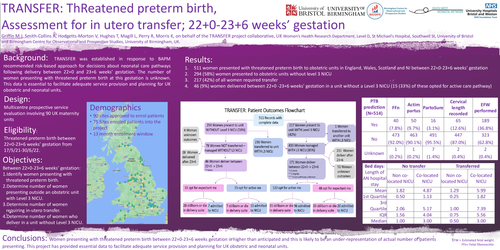
1. 511 women presented with threatened preterm birth to obstetric units in England, Wales, Scotland and NI between 22+0-23+6 weeks’ gestation
2. 294 (58%) women presented to obstetric units without level 3 NICU
3. 217 (42%) of all women required transfer
4. 46 (9%) women delivered between 22+0 -23+6 weeks’ gestation in a unit without a Level 3 NICU (15 (33%) of these opted for active care pathway)
Conclusions: Women presenting with threatened preterm birth between 22+0-23+6 weeks gestation is higher than anticipated and this is likely to be an under-representation of actual number of patients presenting. This project has provided essential data to facilitate adequate service provision and planning for UK obstetric and neonatal units.