1,830 posters, 67 videos, 75 audios, 29 topics, 22 sessions, 4,727 authors, 1,697 institutions
ePostersLive by SciGen Technologies S.A. All rights reserved.
RCOG World Congress 2023
June 12 - 14, 2023 | London, UK

EP.0891
Outcomes following full dilation caesarean section with or without fetal pillow
Poster Presenter
Authors
Yin Fong Leung, Holly Lewis, Stanton King Dat Ho, Tin Yan Mimi Seto, Ka Wang Cheung, Thomas Kwok-To Li
Affiliations
Part of Topic
Labour Ward Management
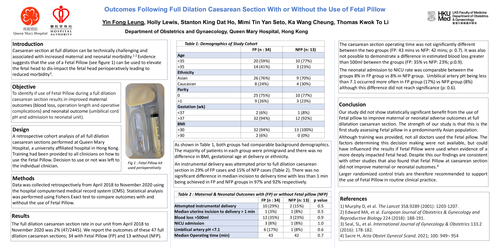
Outcomes Following Full Dilation Caesarean Section With or Without the Use of Fetal Pillow
Introduction
Caesarean section at full dilation can be technically challenging and associated with increased maternal and neonatal morbidity. Evidence suggests that the use of a Fetal Pillow can be used to elevate the fetal head to dis-impact the fetal head perioperatively leading to reduced morbidity.
Objective
To identify if use of Fetal Pillow during a full dilation caesarean section results in improved maternal outcomes (blood loss, operation length and operative complications) and neonatal outcome (umbilical cord pH and admission to neonatal unit).
Design
A retrospective cohort analysis of all full dilation caesarean sections performed at Queen Mary Hospital, a university affiliated hospital in Hong Kong. Training had been provided to all clinicians on how to use the Fetal Pillow. Decision to use or not was left to the individual clinician.
Methods
Data was collected retrospectively from April 2018 to November 2020 using the hospital computerised medical record system (CMS). Statistical analysis was performed using Fishers Exact test to compare outcomes with and without the use of Fetal Pillow.
Results
The full dilation caesarean section rate in our unit from April 2018 to November 2020 was 2% (47/2445). We report the outcomes of these 47 full dilation caesarean sections; 34 with Fetal Pillow (FP) and 13 without (NFP). Both groups had comparable background demographics. The majority of patients in each group were primigravid and there was no difference in BMI, gestational age at delivery or ethnicity.
An instrumental delivery was attempted prior to full dilation caesarean section in 29% of FP cases and 15% of NFP cases. There was no significant difference in median incision to delivery time with less than 1 min being achieved in FP and NFP groups in 97% and 92% respectively. The caesarean section operating time was also not significantly different between the two groups (FP: 43 mins vs NFP: 42 mins; p: 0.7). It was also not possible to demonstrate a difference in estimated blood loss greater than 500ml between the groups (FP: 35% vs NFP: 23%; p:0.9). The neonatal admission to NICU rate was comparable between the groups 8% in FP group vs 8% in NFP group. Umbilical artery pH being less than 7.1 occurred more often in FP group (17%) vs NFP group (8%) although this difference did not reach significance (p: 0.6).
Conclusion
Our study did not show statistically significant benefit from the use of Fetal pillow to improve maternal or neonatal adverse outcomes at full dilatation caesarean section. The strength of our study is that this is the first study assessing Fetal pillow in a predominantly Asian population. Although training was provided, not all doctors used the Fetal pillow. The factors determining this decision making were not available but could have influenced the results if Fetal Pillow were used when evidence of a more deeply impacted Fetal head. Despite this our findings are consistent with other studies that also found that Fetal Pillow at caesarean section did not improve maternal or neonatal outcomes. Larger randomized control trials are therefore recommended to support the use of Fetal Pillow in routine clinical practice.