1,830 posters, 67 videos, 75 audios, 29 topics, 22 sessions, 4,727 authors, 1,697 institutions
ePostersLive by SciGen Technologies S.A. All rights reserved.
RCOG World Congress 2023
June 12 - 14, 2023 | London, UK

EP.0881
Development and internal validation of a prediction model for PPH, Bulawayo, Zimbabwe.
Poster Presenter
Part of Topic
Labour Ward Management
Development and internal validation of a prediction model for PPH, Bulawayo, Zimbabwe.
Ngwenya S, Mhlanga S, Moyo S, Dube H, Musakanda R, Murove B, Dzvore H, Zulu-Moyo L.
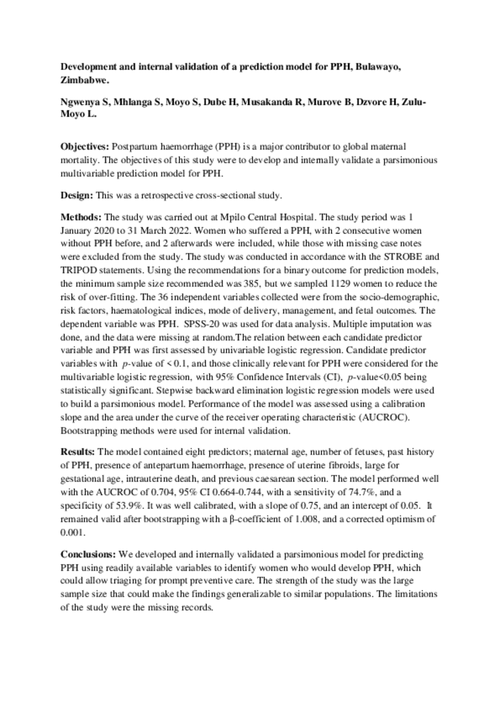
Objectives: Postpartum haemorrhage (PPH) is a major contributor to global maternal mortality. The objectives of this study were to develop and internally validate a parsimonious multivariable prediction model for PPH.
Design: This was a retrospective cross-sectional study.
Methods: The study was carried out at Mpilo Central Hospital. The study period was 1 January 2020 to 31 March 2022. Women who suffered a PPH, with 2 consecutive women without PPH before, and 2 afterwards were included, while those with missing case notes were excluded from the study. The study was conducted in accordance with the STROBE and TRIPOD statements. Using the recommendations for a binary outcome for prediction models, the minimum sample size recommended was 385, but we sampled 1129 women to reduce the risk of over-fitting. The 36 independent variables collected were from the socio-demographic, risk factors, haematological indices, mode of delivery, management, and fetal outcomes. The dependent variable was PPH. SPSS-20 was used for data analysis. Multiple imputation was done, and the data were missing at random.The relation between each candidate predictor variable and PPH was first assessed by univariable logistic regression. Candidate predictor variables with p-value of < 0.1, and those clinically relevant for PPH were considered for the multivariable logistic regression, with 95% Confidence Intervals (CI), p-value<0.05 being statistically significant. Stepwise backward elimination logistic regression models were used to build a parsimonious model. Performance of the model was assessed using a calibration slope and the area under the curve of the receiver operating characteristic (AUCROC). Bootstrapping methods were used for internal validation.
Results: The model contained eight predictors; maternal age, number of fetuses, past history of PPH, presence of antepartum haemorrhage, presence of uterine fibroids, large for gestational age, intrauterine death, and previous caesarean section. The model performed well with the AUCROC of 0.704, 95% CI 0.664-0.744, with a sensitivity of 74.7%, and a specificity of 53.9%. It was well calibrated, with a slope of 0.75, and an intercept of 0.05. It remained valid after bootstrapping with a β-coefficient of 1.008, and a corrected optimism of 0.001.
Conclusions: We developed and internally validated a parsimonious model for predicting PPH using readily available variables to identify women who would develop PPH, which could allow triaging for prompt preventive care. The strength of the study was the large sample size that could make the findings generalizable to similar populations. The limitations of the study were the missing records.