1,830 posters, 67 videos, 75 audios, 29 topics, 22 sessions, 4,727 authors, 1,697 institutions
ePostersLive by SciGen Technologies S.A. All rights reserved.
RCOG World Congress 2023
June 12 - 14, 2023 | London, UK

EP.0877
Induction of labor in gestational diabetes; experience at a tertiary care hospital
Poster Presenter
Authors
Affiliations
Part of Topic
Maternal Medicine
Audio
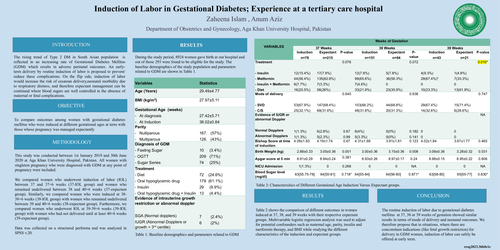
Induction of Labor in Gestational Diabetes; Experience at a tertiary care hospital
Introduction: The rising trend of Type 2 DM in the South Asian population is reflected in an increasing rate of Gestational Diabetes Mellitus (GDM) which results in adverse perinatal outcomes. An early-term delivery by routine induction of labor is proposed to prevent/ reduce these complications. On the flip side, induction of labor would increase the risk of cesarean delivery,neonatal morbidity due to respiratory distress, and therefore expectant management can be continued where blood sugars are well controlled in the absence of maternal or fetal complications.
Objective: To compare outcomes among women with gestational diabetes mellitus who were induced at different gestational ages at term with those whose pregnancy was managed expectantly
Methodology: This study was conducted between 1st January 2019 and 30th June 2020 at Aga Khan University Hospital, Pakistan. All women with singleton pregnancy who were diagnosed with GDM at any point of pregnancy were included.
We compared women who underwent induction of labor (IOL) between 37 and 37+6 weeks (37-IOL group) and women who remained undelivered between 38 and 40+6 weeks (37-expectant group). Similarly, we compared women who were induced at 38-38+6 weeks (38-IOL group) with women who remained undelivered between 39 and 40+6 weeks (38-expectant group). Furthermore, we compared women who underwent IOL at 39-39+6 weeks (39-IOL group) with women who had not delivered until at least 40+6 weeks (39-expectant group).
Data was collected on a structured performa and was analyzed in SPSS v.20.
Results: During the study period, 8924 women gave birth at our hospital and out of those 293 were found to be eligible for the study. The baseline demographics of the study population and parameters related to GDM are shown in Table 1.
Table 2 shows the comparison of different outcomes in women induced at 37, 38, and 39 weeks with their respective expectant groups. Multivariable logistic regression analysis was used to adjust for potential confounders such as maternal age, parity, insulin and metformin therapy, and BMI while studying the different characteristics of the induction and expectant groups.
Conclusion: The routine induction of labor due to gestational diabetes mellitus at 37, 38 or 39 weeks of gestation showed similar results in terms of mode of delivery and neonatal outcomes. We therefore propose that in situations, where there are concomitant indications (like fetal growth restriction) for delivery in GDM women, induction of labor can safely be offered at early term.