1,830 posters, 67 videos, 75 audios, 29 topics, 22 sessions, 4,727 authors, 1,697 institutions
ePostersLive by SciGen Technologies S.A. All rights reserved.
RCOG World Congress 2023
June 12 - 14, 2023 | London, UK

EP.0071
Oral Nifedipine vs Labetalol in management of Postpartum Hypertension: A comparative study
Poster Presenter
Authors
Affiliations
Part of Topic
Maternal Medicine
ORAL LABETALOL VERSUS ORAL NIFEDIPINE FOR THE MANAGEMENT OF POSTPARTUM HYPERTENSION: A COMPARATIVE STUDY
Introduction
The World Health Organization identified hypertensive disorders of pregnancy (HDP) as a dominant cause of maternal death in developing countries(~40%) which accounts for approximately 18% of all maternal deaths worldwide (1). Hypertension in pregnancy is defined by blood pressure (BP) measurements of ≥ 140/ 90 mmHg on two measurements at an interval of 4 hours. BP ≥ 160/110 mmHg on two measurements at 15 20 min apart defines severe hypertension and necessitates immediate treatment to prevent serious complications. Hypertensive disorders of pregnancy may persist post partum or appear for the first time after delivery. The national institute of health and care excellence (NICE) propose treatment of post partum hypertension when BP levels are ≥150/100mmHg checked on two consecutive occasions 4 to 6 hours apart.The ACOG committee (February 2019) recommends using immediate release oral nifedipine as first line therapy when intravenous access is not available or obtained for the treatment of severe intrapartum or post partum hypertension. An alternative option was oral labetalol for the management of severe hypertension ( 2 ). Failure to treat severe hypertension in the post partum period may cause
eclampsia and fatal intracranial haemorrhage (3). Pregnancy associated stroke is more frequent during the delivery and postpartum period, especially in young women where rarer mechanisms like arterial dissections, rupture of arteriovenous malformations, cerebral venous thrombosis, and the reversible cerebral vasoconstriction may exist ( 4 6) Compared to extensive literature discussing antenatal and intrapartum management little evidence exists to guide clinicians in treating postpartum hypertension. The aim of our study was to evaluate the efficacy of two most commonly used drugs i.e. oral labetalol versus oral nifedipine for the management of post partum hypertension.
Aims and Objectives
Primary outcome related:
Time (in hours) to attain sustained blood pressure goal (after treatment initiated with antihypertensive medications) which was defined as the absence of severe hypertension (SBP ≥160mm Hg and/ or DBP ≥ 110 mmHg) for at least 12 hours.
Secondary outcome related:
1. Total length of hospital stay in days [Time Frame: 0 10 days]
2. Need for increased dosing
3. Need for additional oral antihypertensive agents
4. Need for Intravenous antihypertensive
5. Patient reported side effects
Methodology
A Prospective, observational, comparative study in Department of Obstetrics and Gynaecology at a tertiary hospital for a period of two years (2020 2021). We included 60 postnatal mothers >18 year old age with ≥32 weeks gestation who had undergone vaginal delivery or emergency or elective LSCS admitted in labour room through antenatal clinic or emergency room in their antenatal period with gestational hypertension and pre eclampsia (both booked and unbooked cases). Mothers with de novo postpartum hypertension were also included. Patients who were using other anti-hypertensives or had heart block/ renal disease/ asthma/ pre existing diagnosed hypertension were excluded.
Statistical analysis was done using SPSS (version 27.0; SPSS Inc., Chicago, IL, USA) and GraphPad Prism version 5.
Results
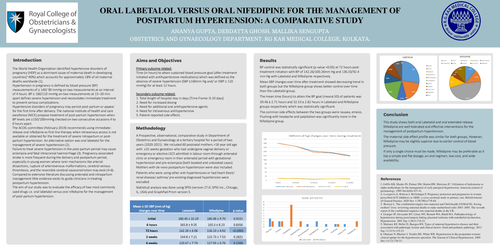
BP control was statistically significant (p value <0.05) at 72 hours post treatment initiation with BP of 142.26/100.26mm Hg and 136.33/92.4 mm Hg with Labetalol and Nifedipine respectively. Mean SBP changes over time after treatment showed decreasing trend in both groups but the Nifedipine group shows better control over time than the Labetalol group. The mean time (hours) to attain the BP goal (mean SD) of patients was 39.46 2.71 hours and 32.53 2.82 hours in Labetalol and Nifedipine groups respectively which was statistically significant. The common side effects between the two groups were nausea, emesis.
Flushing with headache and palpitation
Conclusion
This study shows both oral Labetalol and oral extended release Nifedipine are well tolerated and effective interventions for the management of postpartum hypertension. The maternal side effect profile was similar for both groups, However, Nifedipine may be slightly superior due to earlier control of blood
pressure. If only a single choice must be made, Nifedipine may be preferable as it has a simple and flat dosage, an oral regimen, low cost, and wide
availability.