1,830 posters, 67 videos, 75 audios, 29 topics, 22 sessions, 4,727 authors, 1,697 institutions
ePostersLive by SciGen Technologies S.A. All rights reserved.
RCOG World Congress 2023
June 12 - 14, 2023 | London, UK

EP.0876
The Effectiveness of Pergoveris in a Fertility Clinic
Poster Presenter
Part of Topic
Reproductive Medicine/Assisted Reproduction
The Effectiveness of Pergoveris in a Fertility Clinic
Aisha Brown, Beverly Kimminau, Dr Alka Prakash, Dr Tulay Karasu
Kefford House, Maris Lane, Trumpington, Cambridge, CB2 9LG
Introduction
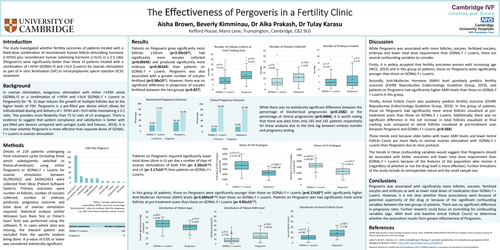
The study investigated whether fertility outcomes of patients treated with a fixed-dose combination of recombinant human follicle-stimulating hormone (r-hFSH) plus recombinant human luteinising hormone (r-hLH) in a 2:1 ratio (Pergoveris) were significantly better than those of patients treated with a combination of r-hFSH(GONAL-f) and r-hLH (Luveris) for ovarian stimulation as part of in vitro fertilisation (IVF) or intracytoplasmic sperm injection (ICSI) treatment.
Background
In ovarian stimulation, exogenous stimulation with either r-hFSH alone (GONAL-f) or a combination of r-hFSH and r-hLH (GONAL-f + Luveris or Pergoveris) for ~8- 12 days induces the growth of multiple follicles due to the higher levels of FSH. Pergoveris is a pre-filled pen device which allows for individualized dosing and delivery of r- hFSHand r-hLH while maintaining a 2:1 ratio. This provides more flexibility than 75 IU vials of LH analogues. There is evidence to suggest that patient compliance and satisfaction is better with pre-filled pen devices compared with syringes (Leão and Esteves, 2014). It is not clear whether Pergoveris is more effective than separate doses of GONAL- f + Luveris in ovarian stimulation.
Methods
Details of 219 patients undergoing fresh treatment cycles (including those which subsequently switched to freeze-all-embryos) using either Pergoveris or GONAL-f + Luverisfor ovarian stimulation between 01/09/2022 and 24/04/2023 were collected from Ideas (Patient Software System). Primary outcomes were number of follicles, number of oocytes collected, number of embryos produced, pregnancy outcome and total dose of ovarian stimulation required. Statistical analysis (either Wilcoxon Sum Rank Test or Fisher’s Exact Test) was performed using the software, R. In cases where data was missing, the relevant patient was excluded from the specific analysis being done. A p-value of 0.05 or lower was considered statistically significant.
Results
Patients on Pergoveris grew significantly more follicles ≥10mm (p=3.39x10⁻⁸), had significantly more oocytes collected (p=0.00345) and produced significantly more embryos (p=0.00164) than patients on GONAL-f + Luveris. Pergoveris was also associated with a greater number of oocytes fertilised (p=5.08x10⁻⁶). However, there was no significant difference in proportion of oocytes fertilised between the two groups (p=0.827). While there was no statistically significant difference between the percentage of biochemical pregnancies (p=0.1582) or the percentage of clinical pregnancies (p=0.4404), it is worth noting that there was data from only 145 and 141 patients respectively for these analyses due to the time lag between embryo transfer and pregnancy testing. Patients on Pergoveris required significantly lower total doses (dose in IU per day x number of days of ovarian stimulation) of both FSH (p= 2.20x10⁻¹⁶) and LH (p= 2.17x10⁻¹⁶) than patients on GONAL-f + Luveris. In this group of patients, those on Pergoveriswere significantly younger than those on GONAL-f + Luveris (p=6.17x10⁻⁸) with significantly higher Anti-Mullerian Hormone (AMH) levels (p=3.369x10⁻¹³) than those on GONAL-f + Luveris. Patients on Pergoverisalso had significantly more antral follicles at pre-treatment scans than those on GONAL-f + Luveris (p= 4.85x10⁻¹³).
Discussion
While Pergoveris was associated with more follicles, oocytes, fertilised oocytes, embryos and lower total dose requirement than GONAL-f + Luveris, there are several confounding variables to consider. Firstly, it is widely accepted that fertility outcomes worsen with increasing age (NICE, 2013) and in this group of patients, those on Pergoveris were significantly younger than those on GONAL-f + Luveris. Secondly, Anti-Mullerian Hormone (AMH) level positively predicts fertility outcome (ESHRE Reproductive Endocrinology Guideline Group, 2019), and patients on Pergoveris had significantly higher AMH levels than those on GONAL-f + Luveris in this group. Thirdly, Antral Follicle Count also positively predicts fertility outcome (ESHRE Reproductive Endocrinology Guideline Group, 2019). In this group of patients, those on Pergoveris had significantly more antral follicles visualised at pre-treatment scans than those on GONAL-f + Luveris. Additionally, there was no significant difference in the net increase in total follicles visualised at final tracking scan compared to antral follicles visualised at pre-treatment scan between Pergoveris and GONAL-f + Luveris (p=0.568). These trends exist because older ladies with lower AMH levels and lower Antral Follicle Count are more likely to receive ovarian stimulation with GONAL-f + Luveris thanPergoveris due to clinic protocol. The trends in these confounding variables would suggest that Pergoveris should be associated with better outcomes and lower total dose requirement than GONAL-f + Luverisbecause of the features of the population who receive it (regardless of whether or not the drug itself is more effective). Further limitations of the study include its retrospective nature and the small sample size.
Conclusions
Pergoveris was associated with significantly more follicles, oocytes, fertilised oocytes and embryos as well as lower total doses of medication than GONAL-f + Luveris. However, it is not clear whether these associations were because of potential superiority of the drug or because of the significant confounding variables between the two groups of patients. There was no significant difference in pregnancy rates. Further research could focus on controlling for confounding variables (age, AMH level and baseline Antral Follicle Count) to determine whether the association results from greater effectiveness of Pergoveris.
References
ESHRE Reproductive Endocrinology Guideline Group, 2019. OVARIAN STIMULATION FOR IVF/ICSI Guideline of the European Society of Human Reproduction and Embryology.
Leão, R. de B.F., Esteves, S.C., 2014. Gonadotropin therapy in assisted reproduction: An evolutionary perspective from biologics to biotech. Clinics. https://doi.org/10.6061/clinics/2014(04)10
National Institute for Health and Care Excellence, 2013. Fertility problems: assessment and treatment Clinical guideline.