1,830 posters, 67 videos, 75 audios, 29 topics, 22 sessions, 4,727 authors, 1,697 institutions
ePostersLive by SciGen Technologies S.A. All rights reserved.
RCOG World Congress 2023
June 12 - 14, 2023 | London, UK

EP.0874
A multivariate logistic regression: Parameters for predicting severity of preeclampsia in Indonesia
Part of Topic
Maternal Medicine
Video
The correlation between red blood cell indices, neutrophil to lymphocyte ratio, and albumin to creatinine ratio on the incidence of preeclampsia
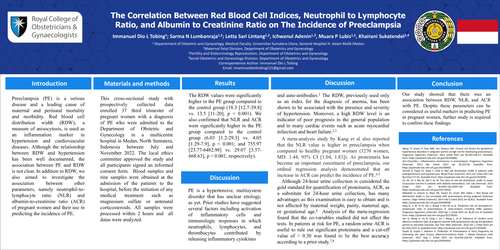
Objective: Preeclampsia (PE) is a serious disease and a leading cause of maternal and perinatal mortality and morbidity. Red blood cell distribution width (RDW), a measure of anisocytosis, is used as an inflammation marker in hypertension and cardiovascular diseases. Although the relationship between RDW and hypertension has been well documented, the association between PE and RDW is not clear. In addition to RDW, we also aimed to investigate the association between other parameters, namely neutrophil-to-lymphocyte ratio (NLR) and albumin-to-creatinine ratio (ACR) of pregnant women and their use in predicting the incidence of PE.
Materials and methods: This prospective cross-sectional study included 74 pregnant women. Of them, 37 had PE, while 37 were healthy, normotensive pregnant women. Blood samples for routine complete blood counts were analyzed.
Results: The RDW values were significantly higher in the PE group compared to the control group (18.3 [12.7-39.8] vs. 13.5 [11-20], p < 0.001). We also confirmed that NLR and ACR were significantly higher in the PE group compared to the control group (6.03 [1.2-29.3] vs. 4.05 [1.29-7.9], p < 0.001; and 755.97 [23.77-6482.98] vs. 29.07 [3.57-668.63], p < 0.001, respectively).
Discussion: PE is a hypertensive, multisystem disorder that has unclear etiology, as yet. Prior studies have suggested several factors including activation of inflammatory cells and immunologic responses in which neutrophils, lymphocytes, and thrombocytes contributed by releasing inflammatory cytokines and auto-antibodies. The RDW, previously used only as an index for the diagnosis of anemia, has been shown to be associated with the presence and severity of hypertension. Moreover, a high RDW level is an indicator of poor prognosis in the general population and in many cardiac events such as acute myocardial infarction and heart failure.A meta-analysis study by Kang et al also reported that the NLR value is higher in preeclampsia when compared to healthy pregnant women (3270 women, MD: 1.44, 95% CI [1.04, 1.83]). As proteinuria has become an important constituent of preeclampsia, our ordinal regression analysis demonstrated that an increase in ACR can predict the incidence of PE. Although 24-hour urine collection is considered the gold standard for quantification of proteinuria, ACR, as a substitute for 24-hour urine collection, has many advantages as this examination is easy to obtain and is not affected by maternal weight, parity, maternal age, or gestational age. Analysis of the meta-regression found that the co-variables studied did not affect the tests. In patients at risk for PE, a random urine ACR is useful to rule out significant proteinuria and a cut-off value of > 0.30 was found to be the best accuracy according to a prior study.
Conclusion: Our study showed that there was an association between RDW, NLR, and ACR with PE. Despite these parameters can be considered as useful markers in predicting PE in pregnant women, further study is required to confirm these findings.
Keywords: pregnancy, preeclampsia, red blood cell distribution width, neutrophil-to-lymphocyte ratio, albumin-to-creatinine ratio