1,830 posters, 67 videos, 75 audios, 29 topics, 22 sessions, 4,727 authors, 1,697 institutions
ePostersLive by SciGen Technologies S.A. All rights reserved.
RCOG World Congress 2023
June 12 - 14, 2023 | London, UK

EP.0872
Antenatal Urinary Tract Abnormalities – A Twelve Month Review of Investigation and Management
Poster Presenter
Authors
Affiliations
Part of Topic
Fetal Medicine
Antenatal Urinary Tract Abnormalities – A Twelve Month Review of Investigation and Management
Glenn Davies, Obstetrics & Gynaecology Specialty Trainee Year 6, University Hospital North Midlands NHS Trust
Gomathy Gopal, Consultant Obstetrician, University Hospital of North Midlands NHS Trust
Introduction
Congenital anomalies of the kidneys and urinary tract (CAKUT) are a common finding in the antenatal period, accounting for 20% of all birth anomalies (1). However, severity ranges from almost certain mortality, usually detected in the first and second trimesters, to minimal impact in the neonatal period (2), usually detected in the third trimester. We sought to review our CAKUT referrals over a 12 month timeline, to investigate neonatal outcomes and fetal medicine input and/or interventions.
Methods
Fetal medicine referrals were reviewed between January to December 2022, including all trimesters as well as including any associated non-CAKUT structural differences. Neonatal records were analysed including if immediate surgical management was required as well as imaging modalities and these findings.
Results
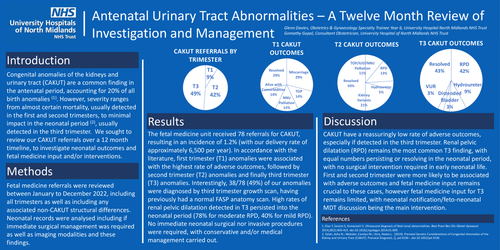
The fetal medicine unit received 78 referrals for CAKUT, resulting in an incidence of 1.2% (with our delivery rate of approximately 6,500 per year). In accordance with the literature, first trimester (T1) anomalies were associated with the highest rate of adverse outcomes, followed by second trimester (T2) anomalies and finally third trimester (T3) anomalies. Interestingly, 38/78 (49%) of our anomalies were diagnosed by third trimester growth scan, having previously had a normal FASP anatomy scan. High rates of renal pelvic dilatation detected in T3 persisted into the neonatal period (78% for moderate RPD, 40% for mild RPD). No immediate neonatal surgical nor invasive procedures were required, with conservative and/or medical management carried out.
Discussion
CAKUT have a reassuringly low rate of adverse outcomes, especially if detected in the third trimester. Renal pelvic dilatation (RPD) remains the most common T3 finding, with equal numbers persisting or resolving in the neonatal period, with no surgical intervention required in early neonatal life. First and second trimester were more likely to be associated with adverse outcomes and fetal medicine input remains crucial to these cases, however fetal medicine input for T3 remains limited, with neonatal notification/feto-neonatal MDT discussion being the main intervention.
References
1. Dias T, Sairam S, Kumarasiri S. Ultrasound diagnosis of fetal renal abnormalities. Best Pract Res Clin Obstet Gynaecol. 2014;28(3):403-415. doi:10.1016/j.bpobgyn.2014.01.009.
2. Talati, Asha N.; Webster, Carolyn M.; Vora, Neeta L. (2019). Prenatal Genetic Considerations of Congenital Anomalies of the Kidney and Urinary Tract (CAKUT). Prenatal Diagnosis, (), pd.5536–. doi:10.1002/pd.5536