1,830 posters, 67 videos, 75 audios, 29 topics, 22 sessions, 4,727 authors, 1,697 institutions
ePostersLive by SciGen Technologies S.A. All rights reserved.
RCOG World Congress 2023
June 12 - 14, 2023 | London, UK

EP.0856
Obstetric Anal Sphincter Injuries (OASIS) in Singaporean Women Having Singleton Vaginal Births
Poster Presenter
Authors
Affiliations
Part of Topic
Labour Ward Management
Obstetric Anal Sphincter Injuries (OASIS) in Singaporean Women Having Singleton Vaginal Births
Background
The Royal College of Obstetricians and Gynaecologists (RCOG) has reported OASIS rates of 6% in nulliparous and 2% in parous women with other risk factors identified; including Asian ethnicity. Singapore is a multiracial Asian society with KK Women’s and Children’s Hospital (KKH) being the largest public hospital providing specialist care for women and children.
Objective
As the incidence of OASIS in Singapore has not been previously reported, the aim of this study is to assess OASIS rates in Singaporean women and further define other concomitant characteristics of this population.
Method
This retrospective study investigates OASIS rates in women following singleton vaginal births at KKH in the year 2021. The analysed data included 7787 singleton vaginal births of gestational age greater than 24+0 weeks, out of the 11628 total births, with the exclusion of multiple pregnancies and deliveries via caesarean section. The data was further characterised in relation to other factors including ethnic category; maternal age; body mass index (BMI); parity; gestational age; labour onset; spontaneous versus assisted delivery; birthweight; and whether an episiotomy was performed.
Results
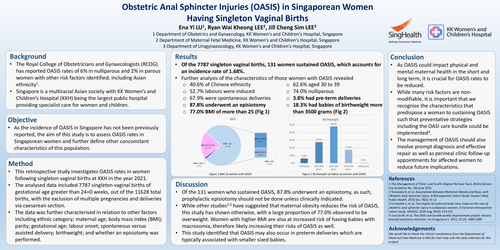
Of the 7787 singleton vaginal births, 131 women sustained OASIS, which accounts for an incidence rate of 1.68%. Further analysis of the characteristics of those women with OASIS revealed 40.6% of Chinese ethnicity, 52.7% labours were induced, 67.9% were spontaneous deliveries, 87.8% underwent an episiotomy, 77.0% BMI of more than 25 (Fig 1), 62.6% aged 30 to 39, 74.0% nulliparous, 3.8% had pre-term deliveries, 18.3% had babies of birthweight more than 3500 grams (Fig 2).
Discussion
Of the 131 women who sustained OASIS, 87.8% underwent an episiotomy, as such, prophylactic episiotomy should not be done unless clinically indicated. While other studies have suggested that maternal obesity reduces the risk of OASIS, this study has shown otherwise, with a large proportion of 77.0% observed to be overweight. Women with higher BMI are also at increased risk of having babies with macrosomia, therefore likely increasing their risks of OASIS as well. This study identified that OASIS may also occur in preterm deliveries which are typically associated with smaller sized babies.
Conclusion
As OASIS could impact physical and mental maternal health in the short and long term, it is crucial for OASIS rates to be reduced. While many risk factors are non- modifiable, it is important that we recognise the characteristics that predispose a woman to sustaining OASIS such that preventative strategies including the OASI care bundle could be implemented. The management of OASIS should also involve prompt diagnosis and effective repair as well as perineal clinic follow up appointments for affected women to reduce future implications.