1,830 posters, 67 videos, 75 audios, 29 topics, 22 sessions, 4,727 authors, 1,697 institutions
ePostersLive by SciGen Technologies S.A. All rights reserved.
RCOG World Congress 2023
June 12 - 14, 2023 | London, UK

EP.0854
Retrospective study on the effects of caesarean niche on IVF outcomes
Poster Presenter
Part of Topic
Hot Topics (Emerging research/issues) in Gynaecology
Retrospective study on the effects of caesarean niche on IVF outcomes
Authors
Stella RS Sugianto, Onn Pei Pei, Elizabeth Chen Mei Hua, Shahul Hameed Mohamed Siraj, Ong Chiou Li, Sadhana Nadarajah
Objective
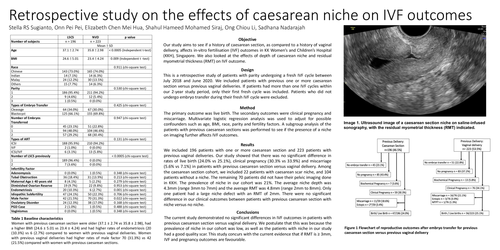
Our study aims to see if a history of caesarean section, as compared to a history of vaginal delivery, affects in-vitro fertilisation (IVF) outcomes in KK Women’s and Children’s Hospital (KKH), Singapore. We also looked at the effects of depth of caesarean niche and residual myometrial thickness (RMT) on IVF outcome.
Design
This is a retrospective study of patients with parity undergoing a fresh IVF cycle between July 2018 and June 2020. We included patients with previous one or more caesarean section versus previous vaginal deliveries. If patients had more than one IVF cycles within our 2-year study period, only their first fresh cycle was included. Patients who did not undergo embryo transfer during their fresh IVF cycle were excluded.
Method
The primary outcome was live birth. The secondary outcomes were clinical pregnancy and miscarriage. Multivariate logistic regression analysis was used to adjust for possible confounders such as age, BMI, race, parity and fertility factors. A subgroup analysis of the patients with previous caesarean sections was performed to see if the presence of a niche on imaging further affects IVF outcomes.
Results
We included 196 patients with one or more caesarean section and 223 patients with previous vaginal deliveries. Our study showed that there was no significant difference in rates of live birth (24.0% vs 25.1%), clinical pregnancy (30.3% vs 33.9%) and miscarriage (5.6% vs 7.1%) in patients with previous caesarean section versus vaginal delivery. Among the caesarean section cohort, we included 22 patients with caesarean scar niche, and 104 patients without a niche. The remaining 70 patients did not have their pelvic imaging done in KKH. The prevalence of niche in our cohort was 21%. The average niche depth was 4.3mm (range 3mm to 7mm) and the average RMT was 4.8mm (range 2mm to 8mm). Only one patient had a large niche defect with an RMT of 2mm. There were no significant difference in our clinical outcomes between patients with previous caesarean section with niche versus no niche.
Conclusions
The current study demonstrated no significant differences in IVF outcomes in patients with previous caesarean section versus vaginal delivery. We postulate that this was because the prevalence of niche in our cohort was low, as well as the patients with niche in our study had a good quality scar. This study concurs with the current evidence that if RMT is ≥ 3mm, IVF and pregnancy outcomes are favourable.