1,830 posters, 67 videos, 75 audios, 29 topics, 22 sessions, 4,727 authors, 1,697 institutions
ePostersLive by SciGen Technologies S.A. All rights reserved.
RCOG World Congress 2023
June 12 - 14, 2023 | London, UK

EP.0837
Outcomes of Women with Primary and Secondary Ovarian Cancer in United States
Part of Topic
Gynae Oncology
Outcomes of Women with Primary and Secondary Ovarian Cancer in the United States
Oluwasegun Akinyemi, MD, MPH, Terhas Asfiha Weldeslase, MD, Irene Moridi, MD, Deborah Makanjuola MD, Eunice Odusanya BS, Mojisola Fasokun MD, Colon-Santos Lynne ,MD, Luo Guoyang, MD, Ph.D.
PURPOSE / OBJECTIVES
Ovarian cancer remains a significant cause of morbidity and mortality among women in the United States. Approximately 20,000 women were diagnosed with the disease in 2022.
Approximately 13,000 women are projected to die from the disease in the same year. A small proportion of these women have ovarian cancer as a second malignancy.
Few studies have explored the influence of previous exposure to cancer screening and treatment on the overall cancer-specific survival in subsequent ovarian malignancy.
OBJECTIVES
In the present study, we explored the characteristics and outcomes among women who developed ovarian cancer as a primary versus second malignancy.
We also determine the risk factors for improved survival among women with ovarian cancers.
MATERIAL & METHODS
We utilized the Surveillance, Epidemiology, and End Results (SEER) 18 Registry to conduct a retrospective analysis of women with a primary diagnosis of ovarian cancer from 2000 to 2019.
Our primary outcome was to determine the cancer-specific mortality rate for this period.
We compared characteristics, and outcomes among women who developed Ovarian cancer as a primary versus second malignancy.
RESULTS
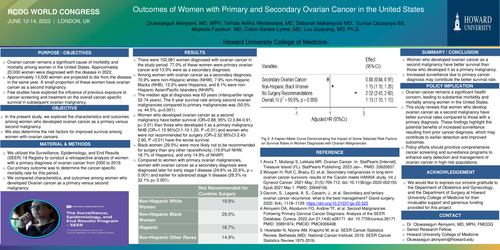
There were 102,981 women diagnosed with ovarian cancer in the study period. 77.0% of these women were primary ovarian cancer and 13.0% were as a secondary diagnosis.
Among women with ovarian cancer as a secondary diagnosis, 70.9% were non-Hispanic whites (NHW), 7.9% non-Hispanic Blacks (NHB), 13.2% were Hispanics, and 8.1% were non-Hispanic Asian/Pacific Islanders (NHAPI).
The median age at diagnosis was 63 years (interquartile range 52-74 years). The 5-year survival rate among second ovarian malignancies compared to primary malignancies was (50.5% vs. 44.5%, p<0.001).
Women who developed ovarian cancer as a second malignancy have better survival (OR=0.88, 95% CI 0.84-0.91, p< 0.01) than those who developed it as a primary malignancy. NHB (OR=1.15 95%CI 1.10-1.20, P <0.01) and women who were not recommended for surgery (OR=2.52 95%CI 2.43-2.60, P <0.01) have the worse survival.
Black women (29.5%) were more likely not to be recommended for surgery than any other race/ethnicity; (19.9%of NHW, 18.7% of Hispanics, and only 14.9% of NHAPI.
Compared to women with primary ovarian malignancies, women with ovarian cancer as a secondary diagnosis were diagnosed later for early stage I disease (24.6% vs 22.6%, p < 0.001) and earlier for advanced stage V disease (28.3% vs 32.1% p< 0.001).
SUMMARY / CONCLUSION
Women who developed ovarian cancer as a second malignancy have better survival than those who developed it as a primary malignancy.
Increased surveillance due to primary cancer diagnosis may contribute the better survival rate
POLICY IMPLICATION
Ovarian cancer remains a significant health concern, leading to substantial morbidity and mortality among women in the United States.
This study reveals that women who develop ovarian cancer as a second malignancy have better survival rates compared to those with a primary diagnosis. These findings highlight the potential benefits of increased surveillance resulting from prior cancer diagnosis, which may contribute to earlier detection and improved outcomes.
Policy efforts should prioritize comprehensive cancer screening and surveillance programs to enhance early detection and management of ovarian cancer in high-risk populations.
ACKNOWLEDGEMENT
We would like to express our sincere gratitude to the Department of Obstetrics and Gynecology, and the Department of Surgery at Howard University College of Medicine for their invaluable support and generous funding provided for this project.
REFERENCE
Arora T, Mullangi S, Lekkala MR. Ovarian Cancer. In: StatPearls [Internet]. Treasure Island (FL): StatPearls Publishing; 2023 Jan–. PMID: 33620837.
Woopen H, Rolf C, Braicu EI, et.al. Secondary malignancies in long-term ovarian cancer survivors: results of the 'Carolin meets HANNA' study. Int J Gynecol Cancer. 2021 May; 31(5):709-712. doi: 10.1136/ijgc-2020-002155. Epub 2021 Mar 1. PMID: 33649156.
Garzon, S., Laganà, A. S., Casarin, J., et al. Secondary and tertiary ovarian cancer recurrence: what is the best management? Gland surgery, 2022; 9(4), 1118–1129. https://doi.org/10.21037/gs-20-325
Akinyemi OA, Abodunrin FO, Andine TF, et al. Second Malignancies Following Primary Cervical Cancer Diagnosis: Analysis of the SEER Database. Cureus. 2022 Jun 21;14(6):e26171. doi: 10.7759/cureus.26171. PMID: 35891874; PMCID: PMC9306408.
Howlader N, Noone AM, Krapcho M, et al. SEER Cancer Statistics Review. Bethesda (MD): National Cancer Institute; 2019. SEER Cancer Statistics Review 1975-2016.CONTACT
Dr. Oluwasegun Akinyemi, MD, MPH, FMCOG
Senior Research Fellow,
Howard University College of Medicine
Oluwasegun.akinyemi@howard.edu