1,830 posters, 67 videos, 75 audios, 29 topics, 22 sessions, 4,727 authors, 1,697 institutions
ePostersLive by SciGen Technologies S.A. All rights reserved.
RCOG World Congress 2023
June 12 - 14, 2023 | London, UK

EP.0835
Ambulatory gynaecology shortens the care pathway for patients and saves resources
Poster Presenter
Authors
Affiliations
Part of Topic
Benign Gynaecology
Submission ID
456
Title (required)
Ambulatory gynaecology shortens the care pathway for patients and saves resources
Abstract (required)
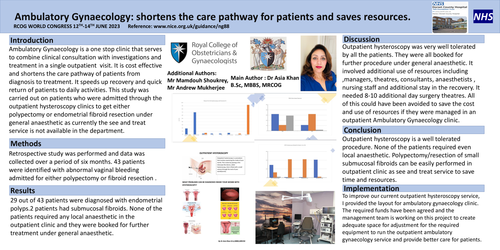
OBJECTIVE: Ambulatory gynaecology shortens the care pathway for patients and saves resources
METHOD: Data was collected over a 6-month period for the patients who were booked for day surgery for hysteroscopy, endometrial polypectomy and trans cervical resection of endometrial fibroids (TCRF). Retrospective review of patient's notes identified 43 patients who were booked for the day surgery procedure under general anaesthetic.29 out of 43 patients were diagnosed with endometrial polyps from the outpatient’s hysteroscopy clinic. None of those patients required local anaesthetic.2 patients were found to have endometrial submucosal fibroids. Outpatient hysteroscopy was not successful for 11 patients due to either pain or cervical stenosis. These patients were booked for further hysteroscopic procedures under general anaesthetic in the day surgery operating theatres at a later date.
CONCLUSION:29 out of 43 patients who underwent hysteroscopy successfully in the outpatient clinic did not even require local anaesthetic. These patients required almost 10-15-day surgery operating theatre lists to be adjusted for the required procedures, consultants time to operate on and the additional workload for the admission team as well as the nursing staff. Additionally, all these patients underwent general anaesthetic which increased their recovery time as well. These patients could have the benefit of see and treat service which could have saved a lot of cost and time. The overall objective of ambulatory gynaecology is to shorten the whole treatment process, speed up recovery and return to work for patients, increase the outpatient procedures, free up capacity on in-patient theatre lists, reduce the number of elective operations cancelled by the hospital and to reduce the overall cost of treatment. Recommendations for the department were to establish an ambulatory gynaecology clinic to improve the service for patients and reduce the cost of treatment. It was agreed with the management to help with providing a better space in order to establish this service as soon as possible. I have provided a layout plan for the proposed room within our existing outpatient clinic. The funds have been granted to start the building alterations to create adequate space for adjusting the required equipment to run the outpatient ambulatory gynaecology service and provide better care for our patients and save the cost.
NICE guideline also recommends the 'see and treat ' service in outpatient hysteroscopy clinics.
Reference: NICE guideline
Published:14 March 2018
www.nice.org.uk/guidance/ng88
Categories
Benign Gynaecology
Authors and Affiliations ( Dr Asia Khan,Mr mamdouh Shoukrey, Mr Andrew Mukherjee)