1,830 posters, 67 videos, 75 audios, 29 topics, 22 sessions, 4,727 authors, 1,697 institutions
ePostersLive by SciGen Technologies S.A. All rights reserved.
RCOG World Congress 2023
June 12 - 14, 2023 | London, UK

EP.0826
Ambulatory Minitouch Endometrial Ablation: Efficacy at 2 year
Poster Presenter
Authors
Affiliations
James cook university hospital, Darlington Memorial Hospital
Part of Topic
Benign Gynaecology
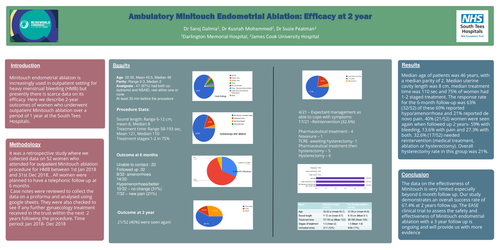
Objective: Minitouch endometrial ablation is increasingly used in an outpatient setting for heavy menstrual bleeding (HMB) but presently there is scarce data on its efficacy. Here we describe 2-year outcomes of women who underwent outpatient Minitouch ablation over a period of 1 year.
Design: It was a retrospective study where we collected data on 52 women who attended for outpatient Minitouch ablation procedures for HMB between 1st Jan 2018 and 31st Dec 2018. All women were planned to have a telephonic follow-up at 6 months.
Methods: Case notes were reviewed to collect the data on a proforma and analyzed using google sheets. They were also checked to see if any further gynaecology treatment was received in the trust within the next 2 years following the procedure.
Results: Median age of patients was 46 years, with a median parity of 2. Median uterine cavity length was 8 cm, median treatment time was 110 sec and 75% of women had 1-2 staged treatments. The response rate for the 6-month follow-up was 63% (32/52) of these 69% reported hypo/amenorrhoea and 21% reported de novo pain. 40% (21/52) of women were seen again when followed up 2 years- 59% with bleeding, 13.6% with pain, and 27.3% with both. 32.6% (17/52) needed reintervention (medical treatment, ablation, or hysterectomy). The overall hysterectomy rate in this group was 21%.
Conclusions: The data on the effectiveness of Minitouch is very limited, especially beyond 6 months of follow-up. Our study demonstrates an overall success rate of 67.4% at 2 years follow-up. The EASE clinical trial to assess the safety and effectiveness of Minitouch endometrial ablation with a 3-year follow-up is ongoing and will provide more evidence.