1,830 posters, 67 videos, 75 audios, 29 topics, 22 sessions, 4,727 authors, 1,697 institutions
ePostersLive by SciGen Technologies S.A. All rights reserved.
RCOG World Congress 2023
June 12 - 14, 2023 | London, UK

EP.0817
Abortions for Lethal Abnormalities in Nigeria following Implementation of Less-restrictive Regulations.
Part of Topic
Abortion Care
Video
Outcome of Abortions for Lethal Congenital Fetal Abnormalities in Nigeria following Transition from Restrictive to less Restrictive Regulations.
Awowole IO1, Adeniyi OA1, Adejuyigbe EA2, Okeniyi JAO2, Anyabolu CH2, Ugowe OJ2, Sowande A3.
- Department of Obstetrics and Gynaecology, Obafemi Awolowo University Teaching Hospitals Complex, Ife, Osun State, Nigeria.
- 2. Department of Paediatrics and Child Health, Obafemi Awolowo University Teaching Hospitals Complex, Ife, Osun State, Nigeria.
- Paediatric Surgery Unit, Department of Surgery, Obafemi Awolowo University Teaching Hospitals Complex, Ife, Osun State, Nigeria.
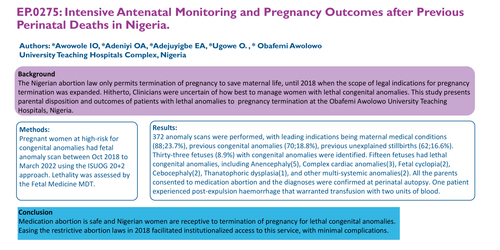
Introduction: The Ministry of Health guideline on termination of pregnancy expanded the scope for legal abortions in 2018. Hitherto, Clinicians were uncertain of how best to manage women with lethal congenital anomalies due to restrictive laws. This study presents the indications, parental disposition to abortion, and clinical outcomes of prenatally diagnosed lethal fetal anomalies at the Obafemi Awolowo University Teaching Hospitals Complex (OAUTHC), Nigeria.
Methodology: Pregnant women at high-risk for congenital anomalies had fetal anomaly scan between 19weeks – 36weeks gestation from October 2018 to March 2022, using the ISUOG 20+2 Planes approach. Identified anomalies were classified into lethal and non-lethal anomalies by a Fetal Medicine Multidisciplinary Team, and the expectant parents were counselled appropriately, including the option of termination of pregnancy for those with lethal anomalies.
Results: There were 372 fetal anomaly scans performed over the period, with the leading indications being maternal medical conditions (88;23.7%), previous congenital anomalies (70;18.8%), previous unexplained stillbirths (62;16.6%), polyhydramnios (56;15.1%) and maternal age>40years (48;12.9%). Thirty-three fetuses (8.9%) with congenital anomalies were identified. Fifteen fetuses had lethal congenital anomalies, including Anencephaly(5), Complex cardiac anomalies(3), Fetal cyclopia(2), Cebocephaly(2), Thanatophoric dysplasia(1), and other multi-systemic anomalies(2). All the parents consented to medication abortion and the diagnoses were confirmed at perinatal autopsy. One patient experienced post-expulsion haemorrhage that warranted transfusion with two units of blood.
Conclusion: Medication abortion is safe and Nigerian women are receptive to termination of pregnancy for lethal congenital anomalies. Easing the restrictive abortion laws in 2018 facilitated institutionalized access to this service, with minimal complications.
Keywords: Maternal mortality, Abprtion, Congenital anomalies, Nigeria