1,830 posters, 67 videos, 75 audios, 29 topics, 22 sessions, 4,727 authors, 1,697 institutions
ePostersLive by SciGen Technologies S.A. All rights reserved.
RCOG World Congress 2023
June 12 - 14, 2023 | London, UK

EP.0303
Modified regimen for mid-trimester medical termination: assessment of safety and effectiveness
Poster Presenter
Part of Topic
Abortion Care
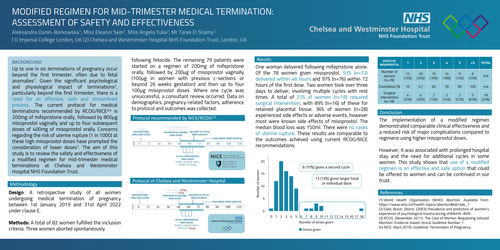
Objective: Up to one in six terminations of pregnancy occur beyond the first trimester, often due to fetal anomalies. Given the significant psychological and physiological impact of terminations, particularly beyond the first trimester, there is a need for an effective, safe and streamlined process. The current protocol for medical terminations recommended by RCOG and NICE is 200mg of mifepristone orally, followed by 800μg misoprostol vaginally and up to four subsequent doses of 400mg of misoprostol orally. Concerns regarding the risk of uterine rupture (1 in 1000) at these high misoprostol doses have prompted the consideration of lower doses. The aim of this study is to review the safety and effectiveness of a modified regimen for mid-trimester medical terminations at Chelsea and Westminster Hospital NHS Foundation Trust.
Design: A retrospective study of all women undergoing medical termination of pregnancy between 1st January 2019 and 31st April 2022 under clause E.
Method: A total of 82 women fulfilled the inclusion criteria. Three women aborted spontaneously following fetocide. The remaining 79 patients were started on a regimen of 200mg of mifepristone orally, followed by 200μg of misoprostol vaginally (100μg in women with previous c-sections or beyond 26 weeks gestation) and then up to four 100μg misoprostol doses. Where one cycle was unsuccessful, a consultant review occurred. Data on demographics, pregnancy-related factors, adherence to protocol and outcomes was collected.
Results: One woman delivered following mifepristone alone. Of the 78 women given misoprostol, 93% (n=73) delivered within 48 hours and 97% (n=76) within 72 hours of the first dose. Two women took over three days to deliver, involving multiple cycles with rest times. A total of 23% of women (n=18) required surgical intervention, with 89% (n=16) of these for retained placental tissue. 36% of women (n=28) experienced side effects or adverse events, however most were known side effects of misoprostol. The median blood loss was 150ml. There were no cases of uterine rupture. These results are comparable to the outcomes achieved using current RCOG/NICE recommendations.
Conclusion: The implementation of a modified regimen demonstrated comparable clinical effectiveness and a reduced risk of major complications compared to regimens using higher misoprostol doses. However, it was associated with prolonged hospital stay and the need for additional cycles in some women. This study shows that use of a modified regimen is an effective and safe option that could be offered to women and can be continued in our trust.