1,830 posters, 67 videos, 75 audios, 29 topics, 22 sessions, 4,727 authors, 1,697 institutions
ePostersLive by SciGen Technologies S.A. All rights reserved.
RCOG World Congress 2023
June 12 - 14, 2023 | London, UK

EP.0080
Evaluation of aspirin provision on pre-term pre-eclampsia rates in a tertiary hospital
Poster Presenter
Authors
Affiliations
School of Medicine, Cardiff University, University Hospital Wales
Part of Topic
Maternal Medicine
Evaluation of midwives’ patient group directive for aspirin provision on rates of preterm pre-eclampsia in a tertiary hospital setting: A patient safety initiative
Ericka Maye1, Amy Robb2
1 Cardiff University
2 University Hospital of Wales
Introduction
Pre-term pre-eclampsia (PTPET) is a hypertensive disorder of pregnancy occurring before 37 weeks’ gestation, characterized by hypertension (≥140/90mmHg) and end organ damage (1). PTPET is associated with significantly higher levels of adverse birth outcomes such as neonatal unit admission, small for gestational age babies and increased perinatal morbidity (2). Screening modalities such as NICE identify those at risk of PET and thus require aspirin (3). Low dose aspirin (75-150mg) has been shown to significantly reduce preterm PET in double blind multi-center randomized controlled trials (4).
Methods
All births occurring from 1st of January 2014 to 15th March 2022 in University Hospital Wales (UHW) were included in this retrospective study. Exclusion criteria included terminations of pregnancy and unknown gestational age. A patient group directive (PGD) for the provision of aspirin for those at risk of PET came into effect in 2017. Study groups were divided into ‘before aspirin’, ‘75mg aspirin’ and ‘150 aspirin’ respectively and compared. Statistical analyses were carried out using GraphPad Prism Version 9.3.1 and IBM SPSS Statistics Version 27.
Results
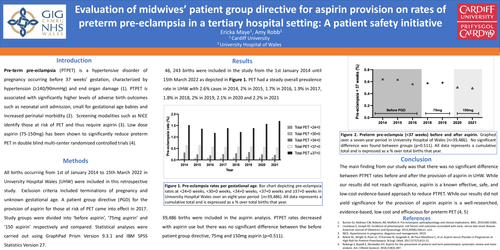
46, 243 births were included in the study from the 1st January 2014 until 15th March 2022 as depicted in Figure 1. PET had a steady overall prevalence rate in UHW with 2.6% cases in 2014, 2% in 2015, 1.7% in 2016, 1.9% in 2017, 1.8% in 2018, 2% in 2019, 2.1% in 2020 and 2.2% in 2021.
39,486 births were included in the aspirin analysis. PTPET rates decreased with aspirin use but there was no significant difference between the before patient group directive, 75mg and 150mg aspirin (p=0.511).
Conclusion
The main finding from our study was that there was no significant difference between PTPET rates before and after the provision of aspirin in UHW. While our results did not reach significance, aspirin is a known effective, safe, and low-cost evidence-based approach to reduce PTPET. While our results did not yield significance for the provision of aspirin aspirin is a well-researched, evidence-based, low cost and efficacious for preterm PET (4, 5)