1,830 posters, 67 videos, 75 audios, 29 topics, 22 sessions, 4,727 authors, 1,697 institutions
ePostersLive by SciGen Technologies S.A. All rights reserved.
RCOG World Congress 2023
June 12 - 14, 2023 | London, UK

EP.0795
Hydrodissection of Labial Adhesions in a Prepubertal Female in Low Resource Setting
Poster Presenter
Authors
Affiliations
Part of Topic
Adolescent Gynaecology
Hydrodissection of Labial Adhesions in a Prepubertal Female in Low Resource Setting
Dr. Giovana Charite, Dr. Shamanique Bodie-Williams
Rand Memorial Hospital, Grand Bahama, Bahamas
Objective
To discuss the case of a 4-year-old female with labial adhesions that failed medical management and was treated surgically through hydrodissection in a resource limited setting.
Case Report
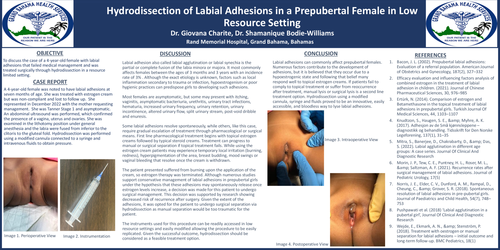
A 4-year-old female was noted to have labial adhesions at seven months of age. She was treated with estrogen cream but was non-compliant and lost to follow up. She represented in December 2022 with the mother requesting management. She was Tanner Stage 1 and asymptomatic. An abdominal ultrasound was performed, which confirmed the presence of a vagina, uterus and ovaries. She was examined in the lithotomy position under general anesthesia and the labia were fused from inferior to the clitoris to the gluteal fold. Hydrodissection was performed using a modified cannula connected to a syringe and intravenous fluids to obtain pressure.
Discussion
Labial adhesion also called labial agglutination or labial synechia is the partial or complete fusion of the labia minora or majora. It most commonly affects females between the ages of 3 months and 3 years with an incidence rate of 3% . Although the exact etiology is unknown, factors such as local inflammation secondary to trauma or infection, hypoestrogenism or poor hygienic practices can predispose girls to developing such adhesions.
Most females are asymptomatic, but some may present with itching, vaginitis, asymptomatic bacteriuria, urethritis, urinary tract infections, hematuria, increased urinary frequency, urinary retention, urinary incontinence, altered urinary flow, split urinary stream, post-void dribble and enuresis.
Some labial adhesions resolve spontaneously, while others, like this case, require gradual escalation of treatment through pharmacological or surgical means. First line pharmacological treatment begins with topical estrogen creams followed by typical steroid creams. Treatment can progress to manual or surgical separation if topical treatment fails. While using the estrogen cream patients may experience temporary local irritation (burning, redness), hyperpigmentation of the area, breast budding, mood swings or vaginal bleeding that resolve once the cream is withdrawn.
The patient presented suffered from burning upon the application of the cream, so estrogen therapy was terminated. Although numerous studies support conservative management of labial adhesions in prepubertal girls under the hypothesis that these adhesions may spontaneously release once estrogen levels increase, a decision was made for this patient to undergo surgical management. This decision was supported by research showing decreased risk of recurrence after surgery. Given the extent of the adhesions, it was opted for the patient to undergo surgical separation via hydrodissection as manual separation would be too traumatic for the patient.
The instruments used for this procedure can be readily accessed in low resource settings and easily modified allowing the procedure to be easily replicated. Given the successful outcome, hydrodissection should be considered as a feasible treatment option.
Conclusion
Labial adhesions can commonly affect prepubertal females. Numerous factors contribute to the development of adhesions, but it is believed that they occur due to a hypoestrogenic state and following that belief many respond well to topical estrogen creams. If patients fail to comply to topical treatment or suffer from reoccurrence after treatment, manual lysis or surgical lysis is a second line treatment option. Hydrodissection using a modified cannula, syringe and fluids proved to be an innovative, easily accessible, and bloodless way to lyse labial adhesions.