1,830 posters, 67 videos, 75 audios, 29 topics, 22 sessions, 4,727 authors, 1,697 institutions
ePostersLive by SciGen Technologies S.A. All rights reserved.
RCOG World Congress 2023
June 12 - 14, 2023 | London, UK

EP.0143
Poorly-differentiated Ovarian Sertoli-Leydig Cell Tumour in a pre-pubertal girl with DICER-1 mutation
Poster Presenter
Authors
Vedhapriya Sudhakar, Philippa Dann, Bansari Trivedi, Sreeparna Biswas, Krishen Sieunarine
Affiliations
Part of Topic
Adolescent Gynaecology
Poorly-differentiated Ovarian Sertoli-Leydig Cell Tumour in a pre-pubertal girl with DICER-1 mutation
Dr Vedhapriya Sudhakar1, Miss Philippa Dann2, Miss BansariTrivedi3, Miss SreeparnaBiswas4 , Mr KrishenSieunarine5
1Specialty Registrar, Obstetrics and Gynaecology, 2,3,4,5 Consultant in Obstetrics and Gynaecology, Kettering General Hospital, Kettering
Background
Sertoli-Leydig cell tumours (SLCT) are a form of malignant mixed sex-cord tumours representing <0.5% of primary ovarian neoplasms. 1
We present the youngest case, in an emergency setting, reported in literature of a girl who was diagnosed with spontaneous rupture of an ovarian, poorly differentiated Sertoli-Leydig cell tumour, detected to have DICER-1 mutation.
Case Report
Presentation:
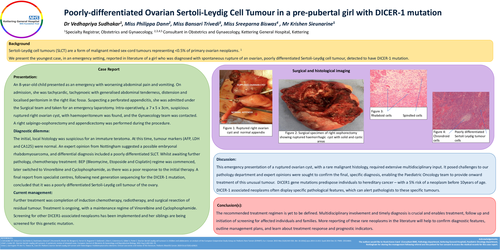
An 8-year-old child presented as an emergency with worsening abdominal pain and vomiting. On admission, she was tachycardic, tachypnoeic with generalised abdominal tenderness, distension and localised peritonism in the right iliac fossa. Suspecting a perforated appendicitis, she was admitted under the Surgical team and taken for an emergency laparotomy. Intra-operatively, a 7 x 5 x 3cm, suspicious ruptured right ovarian cyst, with haemoperitoneum was found, and the Gynaecology team was contacted. A right salpingo-oophorectomy and appendicectomy was performed during the procedure.
Diagnostic dilemma:
The initial, local histology was suspicious for an immature teratoma. At this time, tumour markers (AFP, LDH and CA125) were normal. An expert opinion from Nottingham suggested a possible embryonal rhabdomyosarcoma, and differential diagnosis included a poorly differentiated SLCT. Whilst awaiting further pathology, chemotherapy treatment: BEP (Bleomycine, Etoposide and Cisplatin) regime was commenced, later switched to Vinorelbine and Cyclophosphamide, as there was a poor response to the initial therapy. A final report from specialist centres, following next generation sequencing for the DICER mutation, concluded that it was a poorly differentiated Sertoli-Leydig cell tumour of the ovary.
Current management:
Further treatment was completion of induction chemotherapy, radiotherapy, and surgical resection of residual tumour. Treatment is ongoing, with a maintenance regime of Vinorelbine and Cyclophosphamide. Screening for other DICER1-associated neoplasms has been implemented and her siblings are being screened for this genetic mutation.
Discussion:
This emergency presentation of a ruptured ovarian cyst, with a rare malignant histology, required extensive multidisciplinary input. It posed challenges to our pathology department and expert opinions were sought to confirm the final, specific diagnosis, enabling the Paediatric Oncology team to provide onward treatment of this unusual tumour. DICER1 gene mutations predispose individuals to hereditary cancer – with a 5% risk of a neoplasm before 10years of age. DICER-1 associated neoplasms often display specific pathological features, which can alert pathologists to these specific tumours.
Conclusion(s):
The recommended treatment regimen is yet to be defined. Multidisciplinary involvement and timely diagnosis is crucial and enables treatment, follow up and initiation of screening for affected individuals and families. More reporting of these rare neoplasms in the literature will help to confirm diagnostic features, outline management plans, and learn about treatment response and prognostic indicators