1,830 posters, 67 videos, 75 audios, 29 topics, 22 sessions, 4,727 authors, 1,697 institutions
ePostersLive by SciGen Technologies S.A. All rights reserved.
RCOG World Congress 2023
June 12 - 14, 2023 | London, UK

EP.0792
Recurrent Ovarian Vein Thrombosis: A Rare Case with Literature Review.
Poster Presenter
Authors
Affiliations
Part of Topic
Hot Topics (Emerging research/issues) in Gynaecology
Recurrent Ovarian Vein Thrombosis: A Rare Case with Literature Review
D. Hag Mohamed ST3 Clinical Fellow S.Akhtar Consultant Obstetrician and Gynecologist
Introduction :
Ovarian vein thrombosis (OVT) is a rare type of venous thromboembolism. The commonest risk factors for it are: pregnancy, recent surgery, oral contraceptives, pelvic infections, and malignancies, however, Pregnancy-related OVT are reported to complicate up to 0.18% of pregnancies. Incidence of OVT peaks 6 days after delivery/ miscarriage/ termination.
Method :
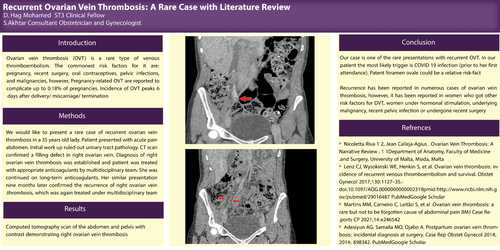
We would like to present a rare case of recurrent ovarian vein thrombosis in a 35 years old lady. Patient presented with acute pain abdomen. Initial work up ruled out urinary tract pathology. CT scan confirmed a filling defect in right ovarian vein. Diagnosis of right ovarian vein thrombosis was established and patient was treated with appropriate anticoagulants by multidisciplinary team. She was continued on long-term anticoagulants. Her similar presentation nine months later confirmed the recurrence of right ovarian vein thrombosis, which was again treated under multidisciplinary team.
Results :
Computed tomography scan of the abdomen and pelvis with contrast demonstrating right ovarian vein thrombosis
Conclusion:
Our case is one of the rare presentations with recurrent OVT. In our patient the most likely trigger is COVID 19 infection (prior to her first attendance). Patent foramen ovale could be a relative risk-fact Recurrence has been reported in numerous cases of ovarian vein thrombosis, however, it has been reported in women who got other risk factors for DVT, women under hormonal stimulation, underlying malignancy, recent pelvic infection or undergone recent surgery