1,830 posters, 67 videos, 75 audios, 29 topics, 22 sessions, 4,727 authors, 1,697 institutions
ePostersLive by SciGen Technologies S.A. All rights reserved.
RCOG World Congress 2023
June 12 - 14, 2023 | London, UK

EP.0786
Alice in Wonderland Syndrome in Pregnancy
Poster Presenter
Authors
Affiliations
Part of Topic
Maternal Medicine
Alice in Wonderland Syndrome in Pregnancy
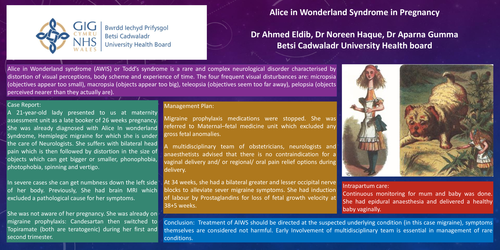
Alice in Wonderland syndrome (AWIS) or Todd’s syndrome is a rare and complex neurological disorder characterised by distortion of visual perceptions, body scheme and experience of time. The four frequent visual disturbances are: micropsia (objectives appear too small), macropsia (objects appear too big), teleopsia (objectives seem too far away), pelopsia (objects perceived nearer than they actually are).
Case Report: A 21-year-old lady presented to us at maternity assessment unit as a late booker of 26 weeks pregnancy. She was already diagnosed with Alice In wonderland Syndrome, Hemiplegic migraine for which she is under the care of Neurologists. She suffers with bilateral head pain which is then followed by distortion in the size of objects which can get bigger or smaller, phonophobia, photophobia, spinning and vertigo. In severe cases she can get numbness down the left side of her body. Previously, She had brain MRI which excluded a pathological cause for her symptoms. She was not aware of her pregnancy. She was already on migraine prophylaxis: Candesartan then switched to Topiramate (both are teratogenic) during her first and second trimester.
Management Plan: Migraine prophylaxis medications were stopped. She was referred to Maternal–fetal medicine unit which excluded any gross fetal anomalies. A multidisciplinary team of obstetricians, neurologists and anaesthetists advised that there is no contraindication for a vaginal delivery and/ or regional/ oral pain relief options during delivery. At 34 weeks, she had a bilateral greater and lesser occipital nerve blocks to alleviate sever migraine symptoms. She had induction of labour by Prostaglandins for loss of fetal growth velocity at 38+5 weeks.
Intrapartum care: Continuous monitoring for mum and baby was done. She had epidural anaesthesia and delivered a healthy baby vaginally.
Conclusion: Treatment of AIWS should be directed at the suspected underlying condition (in this case migraine), symptoms themselves are considered not harmful. Early Involvement of multidisciplinary team is essential in management of rare conditions