1,830 posters, 67 videos, 75 audios, 29 topics, 22 sessions, 4,727 authors, 1,697 institutions
ePostersLive by SciGen Technologies S.A. All rights reserved.
RCOG World Congress 2023
June 12 - 14, 2023 | London, UK

EP.0780
CLASSICAL CASE OF PERIPARTUM CARDIOMYOPATHY FOLLOWING UNCOMPLICATED PREGNANCY.
Poster Presenter
Part of Topic
Maternal Medicine
CLASSICAL CASE OF PERIPARTUM CARDIOMYOPATHY FOLLOWING UNCOMPLICATED PREGNANCY.
MMH Dissanayake1, WMAPB Walisundara1, SSN Chandrasiri2, RMDB Ranatunga1
1District General Hospital Matale, Sri Lanka
2De Soyza Hospital for Women, Colombo, Sri Lanka
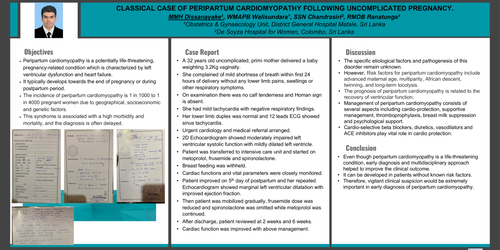
Objective: Peripartum cardiomyopathy is a potentially life-threatening, pregnancy-related condition which is characterized by left ventricular dysfunction and heart failure. It typically develops towards the end of pregnancy or during postpartum period. The incidence of peripartum cardiomyopathy is 1 in 1000 to 1 in 4000 pregnant women due to geographical, socioeconomic and genetic factors. This syndrome is associated with a high morbidity and mortality, and the diagnosis is often delayed.
Case report: A 32 years old uncomplicated, primi mother delivered a baby weighting 3.2Kg vaginally. She complained of mild shortness of breath within first 24 hours of delivery without any lower limb pains, swellings or other respiratory symptoms. On examination there was no calf tenderness and Homan sign is absent. She had mild tachycardia with negative respiratory findings. Her lower limb duplex was normal and 12 leads ECG showed sinus tachycardia. Urgent cardiology and medical referral arranged. 2D Echocardiogram showed moderately impaired left ventricular systolic function with mildly dilated left ventricle. Patient was transferred to intensive care unit and started on metoprolol, frusemide and spironolactone. Breast feeding was withheld. Cardiac functions and vital parameters were closely monitored. Patient improved on 5th day of postpartum and her repeated Echocardiogram showed marginal left ventricular dilatation with improved ejection fraction. Then patient was mobilized gradually, frusemide dose was reduced and spironolactone was omitted while metoprolol was continued. After discharge, patient reviewed at 2 weeks and 6 weeks. Cardiac function was improved with above management.
Discussion: The specific etiological factors and pathogenesis of this disorder remain unknown. However, Risk factors for peripartum cardiomyopathy include advanced maternal age, multiparity, African descent, twinning, and long-term tocolysis. The prognosis of peripartum cardiomyopathy is related to the recovery of ventricular function. Management of peripartum cardiomyopathy consists of several aspects including cardio-protection, supportive management, thromboprophylaxis, breast milk suppression and psychological support. Cardio-selective beta blockers, diuretics, vasodilators and ACE inhibitors play vital role in cardio protection.
Conclusion: Even though peripartum cardiomyopathy is a life-threatening condition, early diagnosis and multidisciplinary approach helped to improve the clinical outcome. It can be developed in patients without known risk factors. Therefore, vigilant clinical suspicion would be extremely important in early diagnosis of peripartum cardiomyopathy.