1,830 posters, 67 videos, 75 audios, 29 topics, 22 sessions, 4,727 authors, 1,697 institutions
ePostersLive by SciGen Technologies S.A. All rights reserved.
RCOG World Congress 2023
June 12 - 14, 2023 | London, UK

EP.0779
Aggressive granulosa cell tumor of ovary: two recurrences in 4 years
Poster Presenter
Part of Topic
Gynae Oncology
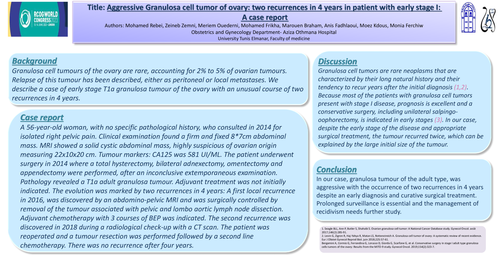
Title: Aggressive Granulosa cell tumor of ovary: two recurrences in 4 years in patient with early stage I:
A case report
Authors: Mohamed Rebei, Zeineb Zemni, Meriem Ouederni, Mohamed Frikha, Marouen Braham, Anis Fadhlaoui, Moez Kdous, Monia Ferchiw
Obstetrics and Gynecology Department- Aziza Othmana Hospital
University Tunis Elmanar, Faculty of medicine
Background
Granulosa cell tumours of the ovary are rare, accounting for 2% to 5% of ovarian tumours. Relapse of this tumour has been described, either as peritoneal or local metastases. We describe a case of early stage T1a granulosa tumour of the ovary with an unusual course of two recurrences in 4 years.
Case report
A 56-year-old woman, with no specific pathological history, who consulted in 2014 for isolated right pelvic pain. Clinical examination found a firm and fixed 8*7cm abdominal mass. MRI showed a solid cystic abdominal mass, highly suspicious of ovarian origin measuring 22x10x20 cm. Tumour markers: CA125 was 581 UI/ML. The patient underwent surgery in 2014 where a total hysterectomy, bilateral adnexectomy, omentectomy and appendectomy were performed, after an inconclusive extemporaneous examination. Pathology revealed a T1a adult granulosa tumour. Adjuvant treatment was not initially indicated. The evolution was marked by two recurrences in 4 years: A first local recurrence in 2016, was discovered by an abdomino-pelvic MRI and was surgically controlled by removal of the tumour associated with pelvic and lombo aortic lymph node dissection. Adjuvant chemotherapy with 3 courses of BEP was indicated. The second recurrence was discovered in 2018 during a radiological check-up with a CT scan. The patient was reoperated and a tumour resection was performed followed by a second line chemotherapy. There was no recurrence after four years.
Discussion
Granulosa cell tumors are rare neoplasms that are characterized by their long natural history and their tendency to recur years after the initial diagnosis (1,2). Because most of the patients with granulosa cell tumors present with stage I disease, prognosis is excellent and a conservative surgery, including unilateral salpingo-oophorectomy, is indicated in early stages (3). In our case, despite the early stage of the disease and appropriate surgical treatment, the tumour recurred twice, which can be explained by the large initial size of the tumour.
Conclusion
In our case, granulosa tumour of the adult type, was aggressive with the occurrence of two recurrences in 4 years despite an early diagnosis and curative surgical treatment. Prolonged surveillance is essential and the management of recidivism needs further study.
References
1. Seagle BLL, Ann P, Butler S, Shahabi S. Ovarian granulosa cell tumor: A National Cancer Database study. Gynecol Oncol. août 2017;146(2):285 91.
2. Levin G, Zigron R, Haj-Yahya R, Matan LS, Rottenstreich A. Granulosa cell tumor of ovary: A systematic review of recent evidence. Eur J Obstet Gynecol Reprod Biol. juin 2018;225:57 61.
Bergamini A, Cormio G, Ferrandina G, Lorusso D, Giorda G, Scarfone G, et al. Conservative surgery in stage I adult type granulosa cells tumors of the ovary: Results from the MITO-9 study. Gynecol Oncol. 2019;154(2):323 7.