1,830 posters, 67 videos, 75 audios, 29 topics, 22 sessions, 4,727 authors, 1,697 institutions
ePostersLive by SciGen Technologies S.A. All rights reserved.
RCOG World Congress 2023
June 12 - 14, 2023 | London, UK

EP.0778
Diabetic Ketoacidosis in Pregnancy Presenting with Acute Concerns About Fetal Wellbeing
Poster Presenter
Authors
Affiliations
Part of Topic
Maternal Medicine
Diabetic Ketoacidosis in Pregnancy Presenting with Acute Concerns About Fetal Wellbeing
Kyei-Sarpong A; Grimshaw E; Barker K
Northumbria Healthcare NHS Trust
INTRODUCTION
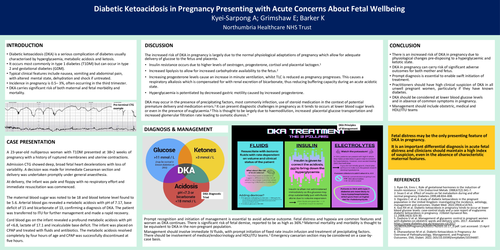
•Diabetic ketoacidosis (DKA) is a serious complication of diabetes usually characterised by hyperglycaemia, metabolic acidosis and ketosis.
•It occurs most commonly in type 1 diabetes (T1DM) but can occur in type 2 and gestational diabetes (GDM).
•Typical clinical features include nausea, vomiting and abdominal pain, with altered mental state, dehydration and shock if untreated.
•Incidence in pregnancy is 0.5–3%,o ften occurring in the third trimester.
•DKA carries significant risk of both maternal and fetal morbidity and mortality.
CASEPRESENTATION
A 23-year-old nulliparous woman with T1DM presented at 38+2 weeks of pregnancy with a history of ruptured membranes and uterine contractions.
Admission CTG showed deep, broad fetal heart decelerations with loss of variability. A decision was made for immediate Caesarean section and delivery was undertaken promptly under general anaesthesia.
At delivery, the infant was pale and floppy with no respiratory effort and immediate resuscitation was commenced.
The maternal blood sugar was noted to be 18 and blood ketone level found to be 5.6. Arterial blood gas revealed a metabolic acidosis with pH of 7.17, base deficit of 15 and bicarbonate of 13, confirming a diagnosis of DKA. The patient was transferred to ITU for further management and made a rapid recovery.
Cord blood gas on the infant revealed a profound metabolic acidosis with pH of <6.8, lactate of 17.1 and incalculable base deficit. The infant was placed on CPAP and treated with fluids and antibiotics. The metabolic acidosis resolved completely by four hours of age and CPAP was successfully discontinued at five hours.