1,830 posters, 67 videos, 75 audios, 29 topics, 22 sessions, 4,727 authors, 1,697 institutions
ePostersLive by SciGen Technologies S.A. All rights reserved.
RCOG World Congress 2023
June 12 - 14, 2023 | London, UK

EP.0773
Severe refractory ITP in pregnancy
Part of Topic
Maternal Medicine
Case Report
Severe Refractory ITP in pregnancy
Objective
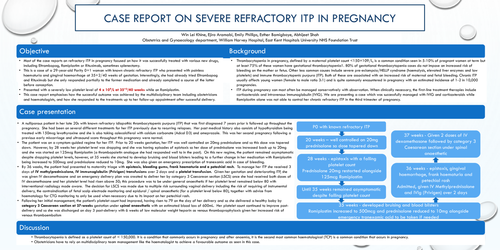
A number of case reports can be seen concerning the treatment of refractory ITP in pregnancy: most of them focusing on how it was successfully treated with various new drugs, including Eltrombopag, Romiplostim or Rituximab, sometimes splenectomy. This is a case of a 29-year-old Parity 0+1 woman with known chronic refractory ITP who presented with painless haematuria and gingival haemorrhage at 35+2/40 weeks of gestation. Interestingly, she had already tried Eltrombopag and Rituximab but she only responded partially to the former medication and already completed a course of the latter before conception. Then, she presented with a severely low platelet level of 4 x 10⁹/L at 35+2/40 weeks while on Romiplostim. This case report emphasises how the successful outcome was achieved by the multidisciplinary team including obstetricians and haematologists, and how she responded to the treatments up to her follow-up appointment after successful delivery.
Background
Thrombocytopenia in pregnancy, defined by a maternal platelet count <150×109/L, is a common condition seen in 5-10% of pregnant women at term but at least 75% of these women have gestational thrombocytopenia1. 80% of gestational thrombocytopenia cases do not impose an increased risk of bleeding on the mother or fetus. Other less common causes include severe pre-eclampsia/HELLP syndrome (haemolysis, elevated liver enzymes and low platelets) and immune thrombocytopenic purpura (ITP). Both of these are associated with an increased risk of maternal and fetal bleeding. Chronic ITP usually affects young women (female to male ratio 3:1) and is quite commonly encountered in pregnancy with an estimated incidence of 1-2 in 10,000 pregnancies1.
ITP during pregnancy can most often be managed conservatively with observation. When clinically necessary, the first-line treatment therapies include corticosteroids and intravenous immunoglobulin (IVIG). We are presenting a case which was successfully managed with IVIG and corticosteroids while Romiplostim alone was not able to control her chronic refractory ITP in the third trimester of pregnancy.
Case Presentation
A nulliparous patient in her late 20s (planned/unplanned pregnancy?) with known refractory idiopathic thrombocytopenic purpura (ITP) that was first diagnosed 7 years prior is followed up throughout he pregnancy. She had been on several different treatments for her ITP previously due to recurring relapses. Her past medical history also consists of hypothyroidism being treated with 150mcg levothyroxine and she is also taking colecalciferol with calcium carbonate (Adcal D3) and omeprazole. This was her second pregnancy following a previous early miscarriage and ultrasound scans throughout this pregnancy were normal.
The patient was on a symptom-guided regime for her ITP. Prior to 20 weeks gestation, her ITP was well controlled on 20mg prednisolone and so this dose was tapered down. However, by 28 weeks her platelet level was dropping and she was having episodes of epistaxis so her dose of prednisolone was increased back up to 20mg and she was started on 125mcg Romiplostim (a thrombopoietin analogue she had responded well to in the past). On this new regime, the patient remained asymptomatic despite dropping platelet levels, however, at 35 weeks she started to develop bruising and blood blisters leading to a further change in her medication with Romiplostim being increased to 500mcg and prednisolone reduced to 10mg. She was also given an emergency prescription of tranexamic acid in case of bleeding.
By 36 weeks, the patient had presented to maternity triage with epistaxis, bleeding gums, frank haematuria and a petechial rash. To manage her ITP she received 3 days of IV methylprednisolone, IV immunoglobulin (Privigen) transfusions over 2 days and a platelet transfusion. Given her gestation and deteriorating ITP, she was given IV dexamethasone and an emergency delivery plan was created to deliver her by category 3 Caesarean section (LSCS) once she had received both doses of IV dexamethasone and her platelet level had risen above 50; this procedure was to be under general anaesthetic if her platelet level remained below 80 with interventional radiology made aware. The decision for LSCS was made due to multiple risk surrounding vaginal delivery including the risk of requiring of instrumental delivery, the contraindication of fetal scalp electrode monitoring and epidural / spinal anaesthetic (for a platelet level below 80), together with advice from haematology for CTG monitoring to only be used when necessary due to its impact on her petechial rash.
Following her initial management, the patient’s platelet count had improved, having risen to 79 on the day of her delivery and so she delivered a healthy baby by category 3 Caesarean section at 37-weeks gestation under spinal anaesthetic with an estimated blood loss of 600mL. Her platelet count continued to improve post-delivery and so she was discharged on day 3 post-delivery with 6 weeks of low molecular weight heparin as venous thromboprophylaxis given her increased risk of venous thromboembolism.
Discussion
Thrombocytopenia is defined as a platelet count of < 150,000. It is a condition that commonly occurs in pregnancy and after anaemia, it is the second most common haematological (TCP) is a common condition that occurs in pregnancy.
Obstetricians have to rely on multidiscip;inary team management like the haematologist to achieve a favourable outcome as seen in this case.