1,830 posters, 67 videos, 75 audios, 29 topics, 22 sessions, 4,727 authors, 1,697 institutions
ePostersLive by SciGen Technologies S.A. All rights reserved.
RCOG World Congress 2023
June 12 - 14, 2023 | London, UK

EP.0766
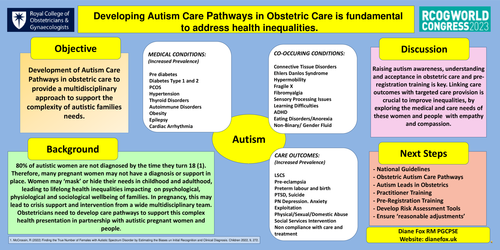
Autism Care Pathways in Obstetric Care are fundamental to address health inequalities.
Poster Presenter
Authors
Affiliations
Part of Topic
Hot Topics (Emerging research/issues) in Obstetrics
to address health inequalities.
80% of autistic women are not diagnosed by the time they turn18 (1).
Therefore, many pregnant women may not have a diagnosis or support in
place.Women may ‘mask’ or hide their needs in childhood and adulthood,
leading to lifelong health inequalities impacting on psychological,
physiological and sociological wellbeing of families.Inpregnancy, this may
lead to crisissupport andintervention from a wide multidisciplinary team.
Obstetricians need to develop care pathways to support this complex
health presentation in partnership with autistic pregnantwomen and
people.
Raising autismawareness, understanding
and acceptance in obstetriccareand pre-
registration training is key. Linking care
outcomes with targetedcare provision is
crucial to improveinequalities, by
exploring the medical and care needs of
thesewomen and peoplewith empathy
and compassion.
Development of Autism Care
Pathways in obstetric care to
provide a multidisciplinary
approach to support the
complexity of autistic families
needs.
-National Guidelines
-Obstetric AutismCare Pathways
-Autism Leads in Obstetrics
-Practitioner Training
-Pre-Registration Training
-Develop Risk Assessment Tools
-Ensure ‘reasonable adjustments’
Objective
Background
Discussion
Next Steps
Autism
Diane Fox RM PGCPSE
Website: dianefox.uk
CARE OUTCOMES:
(Increased Prevalence)
LSCS
Pre-eclampsia
Preterm labour and birth
PTSD, Suicide
PN Depression. Anxiety
Exploitation
Physical/Sexual/Domestic Abuse
Social Services Intervention
Non compliance with care and
treatment
CO-OCCURING CONDITIONS:
Connective Tissue Disorders
Ehlers DanlosSyndrome
Hypermobility
Fragile X
Fibromyalgia
Sensory Processing Issues
Learning Difficulties
ADHD
Eating Disorders/Anorexia
Non-Binary/ Gender Fluid
MEDICAL CONDITIONS:
(Increased Prevalence)
Prediabetes
DiabetesType 1 and 2
PCOS
Hypertension
ThyroidDisorders
AutoimmuneDisorders
Obesity
Epilepsy
CardiacArrhythmia
1. McCrossin, R (2022) Finding the True Number of Females with Autistic Spectrum Disorder by Estimating the Biases un InitialRecognition and Clinical Diagnosis. Children 2022, 9, 272.